“600K Lines in 60 Days” — Garry Tan’s Challenge #
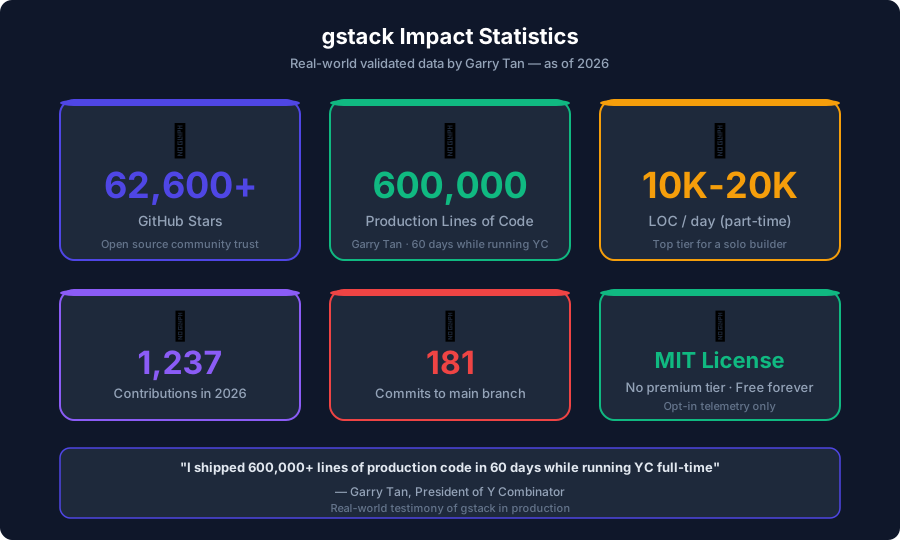
In early 2026, Y Combinator president Garry Tan shared something remarkable: while running YC full-time, he wrote over 600,000 lines of production code in just 60 days. This wasn’t a boast. It was a testimony to what gstack — the tool and the philosophy behind it — makes possible.
10,000 to 20,000 lines per day. Part-time. Solo.
Those numbers are hard to believe at first. In a traditional development environment, they border on impossible. But once you understand gstack’s philosophy, the numbers make complete sense.
This is Part 4 and the final installment of the series. Here we examine why gstack functions not just as a tool but as a development philosophy — covering its three core principles, error philosophy, intentional simplicity, testing strategy, and the future of the solo builder.
Principle 1: Boil the Lake — Completeness is Cheap in the AI Era #
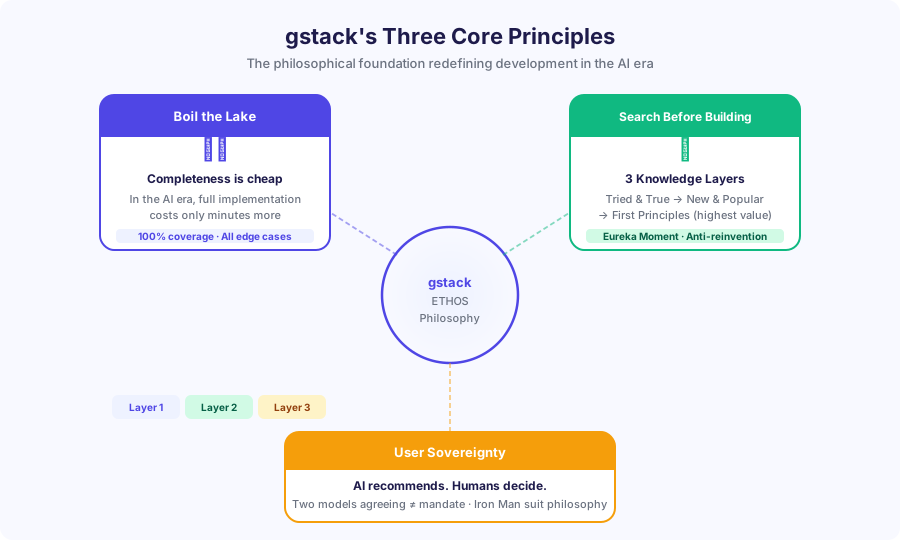
The first principle in gstack’s ETHOS is Boil the Lake. The idea: always choose the complete implementation.
Traditional development culture is dominated by “good enough for now” thinking. Handle edge cases later. Write tests when there’s time. Fix error handling after a bug surfaces. This approach had a rationale — complete implementations used to be expensive.
In the AI era, that premise collapses.
Lakes vs. Oceans #
gstack distinguishes two categories:
- Lakes: Things where complete implementation is realistically achievable. 100% test coverage, all edge cases handled, full error handling — possible at the cost of a few extra minutes.
- Oceans: Things where complete implementation is genuinely unreasonable. Perfect security, infinite scalability, support for every browser.
When AI agents are in the loop, the cost of “Lakes” drops dramatically. If AI can write 100% test coverage in a few additional minutes, why stop at 50%?
Rejecting Deferral #
The core attitude of Boil the Lake is refusing “later”:
|
|
In an age where AI agents write tests, saying “I’ll write tests later” is functionally equivalent to “I’ll never write tests.” gstack starts from this recognition and sets complete implementation as the default.
Principle 2: Search Before Building — 3 Knowledge Layers and the Eureka Moment #
The second principle is Search Before Building. It sounds like simple advice against reinventing the wheel, but gstack systematizes it into something far more precise.
Three Knowledge Layers #
Every technical decision involves three layers of knowledge:
Layer 1 — Tried & True
Patterns battle-tested over years. REST APIs, SQL databases, HTTP cache headers. These are proven and well-documented. In the AI era, it’s still worth occasionally asking “why is this the best approach?” — AI agents may face entirely different tradeoffs.
Layer 2 — New & Popular
Approaches that have risen in the last 6-18 months. GraphQL, Edge Functions, WebAssembly. Their popularity signals value, but their validation period is short. Skeptical evaluation is warranted.
Layer 3 — First Principles
This is the most valuable layer. Original observations about your specific problem. It emerges when you discover constraints or opportunities that no existing approach has accounted for.
The Eureka Moment #
What gstack values most is the Eureka Moment. It unfolds in three steps:
- Understand existing approaches thoroughly (explore Layer 1 + 2)
- Apply reasoning to your specific situation
- Discover why those approaches are suboptimal for your context
gstack’s browser automation is a perfect example. CSS selector-based approaches existed (Layer 1). Playwright’s test recorder existed (Layer 2). But the gstack team discovered that for AI agents, the ARIA accessibility tree was far more stable and framework-agnostic — a Layer 3 insight.
Principle 3: User Sovereignty — AI Recommends, Humans Decide #
The third principle is the most philosophical and the most practical. User Sovereignty.
The core proposition: “AI models recommend. Users decide.”
Two Models Agreeing ≠ A Mandate #
There’s a common misconception: “Claude said it, GPT said it, so it must be right.” gstack explicitly rejects this logic.
Two models agreeing only means that view was common in their training data. Your specific context — team size, technical debt, business constraints, legacy systems — is information no model can fully grasp.
Generation-Verification Loops #
gstack’s actual workflow encodes this principle:
|
|
AI presents recommendations with reasoning, and the user evaluates that reasoning before making the final call. This is the “ask rather than act” principle.
The Iron Man Suit Philosophy #
gstack frequently invokes one analogy: AI is an Iron Man Suit.
When Tony Stark wears the suit, it grants extraordinary capabilities — but Tony is still the decision-maker. The suit might flag “there’s a target at those coordinates,” but the final call belongs to Tony. The suit augments Tony; it doesn’t replace him.
gstack’s AI agents work the same way. They generate code at incredible speed, write tests, automate browsers — but architecture direction, business priorities, and technical tradeoffs remain in human hands.
Error Philosophy: Error Messages Are for Agents, Not Humans #
gstack’s approach to error handling is radical: error messages are written for AI agents, not for humans.
Bad Error vs. Good Error #
A traditional error message:
|
|
This stack trace is useful when a human developer is debugging. But to an AI agent, it’s useless. The agent has no idea what to do next.
A gstack error message:
|
|
Every error must be actionable. When an error occurs, the next action should be immediately clear.
Crash Recovery: Restart, Not Reconnect #
Another distinctive gstack choice: instead of complex reconnection logic, restart is the default recovery strategy.
When a WebSocket connection drops, rather than implementing complex reconnection state machines, gstack restarts the browser daemon. This is simpler, eliminates state-mismatch bugs, and is far easier for AI agents to reason about.
Intentionally Not Implemented — The Value of Simplicity #
Some of the most interesting design decisions in gstack are about what was deliberately not built.
WebSocket Streaming — Not Needed #
Many AI tools use WebSockets for real-time streaming. gstack concluded that HTTP polling is sufficient. Why:
- AI agents don’t need real-time streaming UI the way humans do
- HTTP is simpler, cacheable, and easier to debug
- Receiving results and observing progress are different problems
MCP Protocol — JSON Schema Overhead #
Model Context Protocol is a great standard, but gstack chose its own skill system. The JSON schema serialization/deserialization overhead of MCP cost more than it benefited for gstack’s usage patterns.
Multi-user Support — Out of Scope #
gstack is a local development tool for a single developer or single team. It does not aim to be multi-user SaaS. This scope constraint keeps the codebase dramatically simpler.
Linux/Windows Cookie Decryption — Not Supported #
macOS Keychain cookie decryption is supported, but Linux’s gnome-keyring and Windows DPAPI are not. The complexity-to-value ratio was deemed too low. Some users disagree with this call, but the gstack team made this tradeoff explicitly.
Simplicity is a feature. What was not built is what keeps gstack understandable, maintainable, and trustworthy.
Testing Philosophy: Tier 1/2/3 Cost-Effectiveness #
gstack’s testing strategy optimizes for both cost and coverage simultaneously. It operates across three tiers.
Tier 1: Static Validation (Free, Under 5 Seconds) #
|
|
- Cost: Free (local execution)
- Time: Under 5 seconds
- Coverage: Every commit
- Purpose: Block obvious errors immediately
This layer always runs. It’s the first step in the CI/CD pipeline, and failure here blocks all subsequent steps.
Tier 2: E2E Tests (~$3.85, ~20 Minutes) #
|
|
- Cost: ~$3.85 in Claude API costs
- Time: ~20 minutes total
- Coverage: Before PRs or releases
- Purpose: Verify behavior in real environments
This layer has a cost, but it’s acceptable. $3.85 for full E2E coverage of the skill suite is a reasonable investment.
Tier 3: LLM-as-Judge (~$0.15, ~30 Seconds) #
|
|
- Cost: ~$0.15
- Time: ~30 seconds
- Coverage: Documentation and prompt quality
- Purpose: Verify AI agents understand correctly
The third tier is especially interesting. For AI to use tools correctly, documentation and error messages must be clear to AI. What’s easy for humans to read and what’s easy for AI to parse can diverge. LLM-as-Judge measures that gap.
The Age of the Solo Builder: How Developer Roles Are Changing #
The future gstack envisions is one where the developer’s role changes fundamentally.
From Coder to Orchestrator #
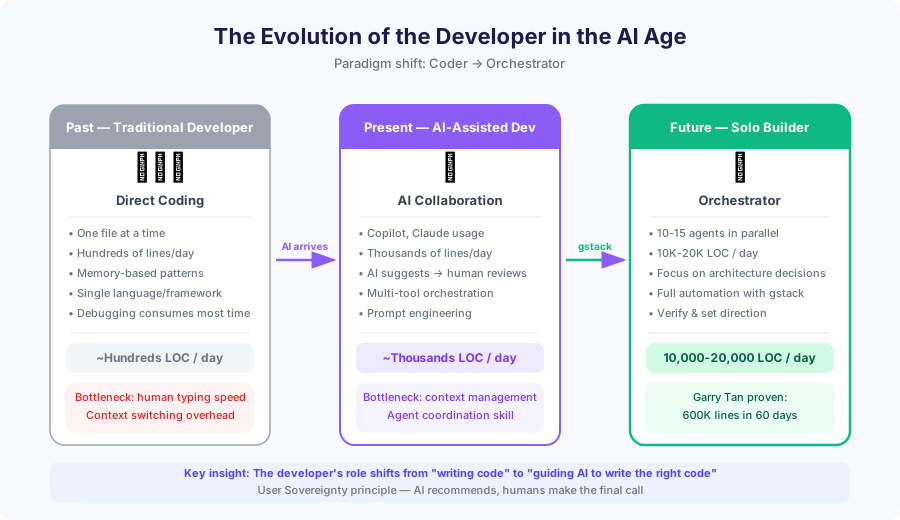
The developer of the past wrote code directly. Opening an IDE, typing functions, chasing bugs — that was the daily reality. Writing hundreds of lines a day was excellent productivity.
The developer in the gstack era is an orchestrator. Coordinating 10-15 AI agents simultaneously, making architecture decisions, setting direction, verifying outcomes. Judgment — not typing speed — becomes the bottleneck.
This shift changes which skills matter:
Declining importance:
- Memorizing specific languages and frameworks
- Typing speed
- Low-level implementation details
Growing importance:
- Systems thinking and architectural intuition
- Ability to direct and evaluate AI agents
- Translating business requirements into technical specs
- Judging quality of generated output
The Possibility of a One-Person Team #
Garry Tan’s case is an extreme example, but it shows the direction. Projects that once required 10 people, now completable by one — with the right tools and the right philosophy.
gstack is that philosophy, implemented in code.
Series Recap + How to Get Started #
Four posts to cover gstack in full.
Part 1: Introduction and Overview
- What gstack is and why it was built
- Core components: Skills, Browser Automation, Conductor
- The 62,600+ star open source ecosystem
Part 2: Installation and Core Workflow
- macOS installation (under 5 minutes)
- Claude Desktop integration
- Running built-in skills and writing custom skills
.gstack/project configuration
Part 3: Browser Automation and Multi-Agent
- ARIA-based Ref system
- Three-layer browser daemon architecture
- Conductor for 10-15 parallel agent execution
- Real-world usage patterns
Part 4: Philosophy and the Future (this post)
- Boil the Lake, Search Before Building, User Sovereignty
- Error philosophy for agents
- Intentional simplicity
- The future of the solo builder
Getting Started Right Now #
|
|
gstack on GitHub: github.com/gstack/gstack
Closing: “The Iron Man Suit of the AI Age” #
When you first encounter gstack, it looks like a tool. A utility for running skills, automating browsers, spinning up parallel agents.
Look deeper, and it’s a philosophy implemented in code.
- Completeness isn’t expensive — not in the AI era. (Boil the Lake)
- Search first, build second. (Search Before Building)
- AI is the suit, not the driver. (User Sovereignty)
Garry Tan wrote 600K lines in 60 days not simply because he had a good tool. He had a clear philosophy about how to use AI agents effectively.
The age of the solo builder has already begun. gstack is the Iron Man Suit for that age.
gstack Complete Guide Series
- Part 1: Introducing gstack — Development Tools for the AI Agent Era
- Part 2: Installation and Core Workflow
- Part 3: Browser Automation and Multi-Agent Execution
- Part 4: Development Philosophy for the AI Age ← current post