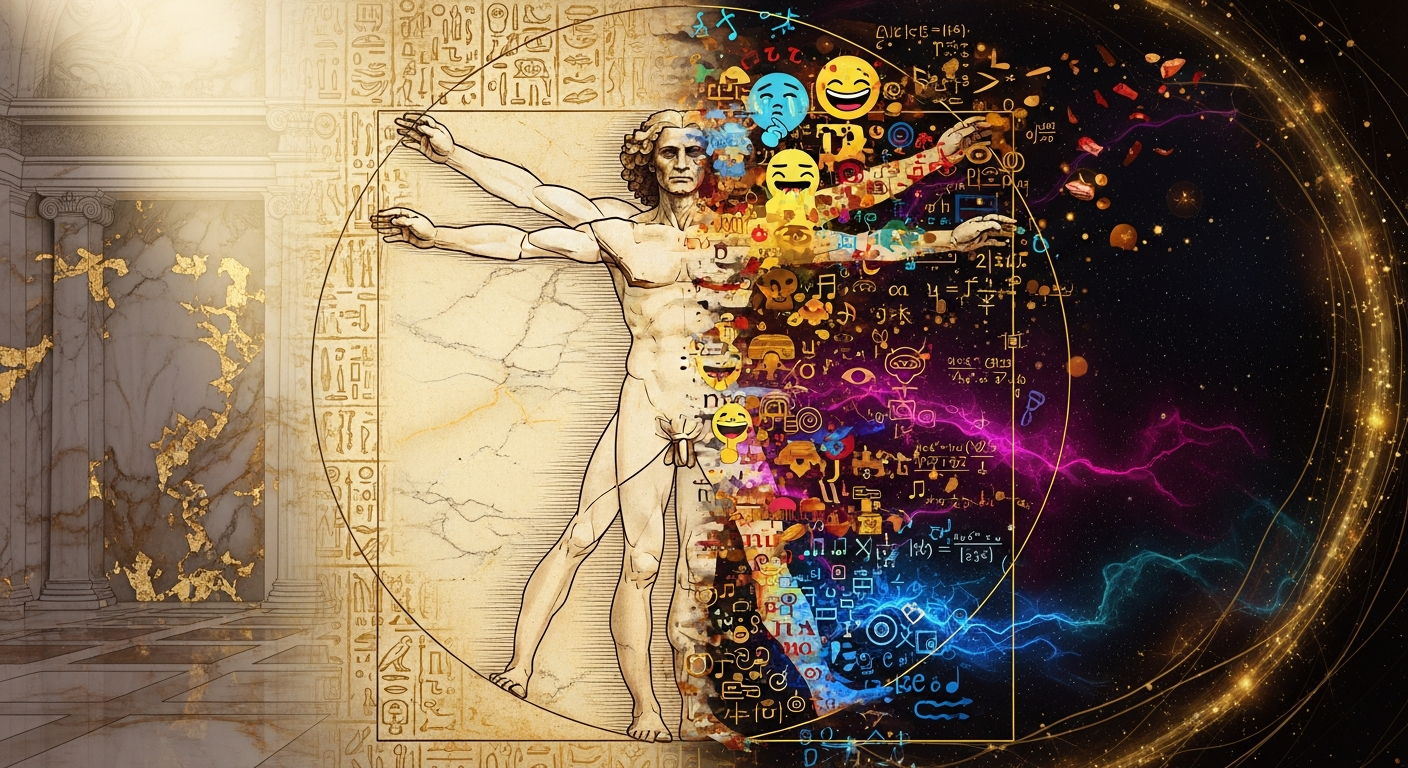
Were you already “you” the moment you were born? Or are you still being made right now, in this very moment?
Two thinkers take their positions. The Essentialist stands on Aristotle’s shoulders and argues that human beings carry a fixed, universal nature — a set of defining characteristics that make us what we are regardless of time, place, or circumstance. The Anti-Essentialist wields Sartre and argues that essence is a fiction, that humans are radically open projects who define themselves through their choices. Ten rounds. The weight of a single word — human — hangs in the balance.
Round 1: Opening Blow — Reason as Nature #
Essentialist: Humans are defined before they choose. Reason, language, moral judgment — Aristotle named it cleanly: the human being is a rational animal. This isn’t a preference or an achievement. It’s a nature. Dogs bark. Birds fly. Humans think. That thinking — that capacity for reason — is not something we acquire. It’s what we are. Strip it away and you don’t have a different kind of human. You have something else entirely.
Anti-Essentialist: Does a newborn infant philosophize? Reason is not installed at birth — it’s built through years of language acquisition, social interaction, and cognitive development. Sartre said it precisely: existence precedes essence. A hammer is made with its purpose already determined — it exists to hammer. But a human being arrives first, and only afterward begins the process of deciding what they are for. The nature you’re describing isn’t discovered. It’s retroactively assigned.
Round 2: The Feral Child and Universal Grammar #
Anti-Essentialist: Consider feral children — Victor of Aveyron, Kamala and Amala of India. Children raised outside human society who walked on all fours, communicated with animal sounds, showed none of what we call “distinctly human” traits. If human essence is innate and indelible, why does the removal of human environment almost entirely suppress it? The essence you’re defending collapses under the weight of a single childhood.
Essentialist: Those same children, when reintroduced to human society, could still learn language — haltingly, incompletely, but the capacity was there. Why? Because Chomsky’s universal grammar is hardwired into the human brain. Every known human language — across thousands of unconnected cultures — shares deep structural features. No other species develops language this way. That neurological architecture, present in every human brain regardless of upbringing, is exactly what I mean by essence. The capacity is innate even when the environment suppresses its expression.
Round 3: Universal Structures vs. Convergent Evolution #
Essentialist: Language is just one instance. Every human culture independently developed morality, religion, and hierarchical social organization. Isolated civilizations on separate continents, with no contact for thousands of years, converged on structurally similar answers to structurally similar problems. That convergence isn’t coincidence. It’s the signature of a shared design. A common human nature producing common human patterns.
Anti-Essentialist: That’s convergent evolution, not essence. Sharks and dolphins look similar — streamlined bodies, fins — but they’re on completely different evolutionary branches. Similar environments produce similar solutions. The fact that multiple cultures developed hierarchies doesn’t mean hierarchy is built into human nature; it means hierarchy is a natural response to the problem of organizing groups with unequal resources and power. Show me a universal that isn’t better explained by shared ecological constraints. Your “human essence” is indistinguishable from “humans face similar problems.”
Round 4: Trans Identity and the Limits of Fixed Categories #
Anti-Essentialist: Explain transgender identity within your framework. Essentialism, if it’s grounded in any biological reality, would presumably treat biological sex as a core human attribute — part of what you are, not what you choose. But transgender people experience a profound and irreducible mismatch between their biological body and their psychological identity. Which side is the “real” essence? The moment you try to answer that question within essentialism, you end up declaring one configuration more authentically human than another.
Essentialist: That’s a category error. The essence I’m defending — rationality, language, empathy, moral agency — has nothing to do with sex or gender. A trans person possesses all of those capacities fully. Their transness doesn’t diminish their humanity in any essentialist framework I’d endorse.
Anti-Essentialist: But you keep having to revise the list. First it was reason, then language, then empathy, then moral agency. Every time a counterexample challenges your current definition of essence, you update the list. A theory that requires continuous revision in response to counterexamples isn’t discovering essence — it’s negotiating it. That’s my argument made visible.
Round 5: Neurodiversity and the Width of the Human #
Essentialist: The existence of neurodiversity actually confirms my core claim. People with autism, ADHD, Down syndrome — all of them are unambiguously human. All of them form relationships, experience emotion, pursue meaning, and navigate the world with some form of agency. These shared capacities, expressed in enormously varied ways, constitute the essential human core.
Anti-Essentialist: Listen to what you’re conceding. You just said “expressed in enormously varied ways” — which means the surface presentation differs so dramatically that the “essence” can only be identified at a level of abstraction so high it barely means anything. And there’s a harder problem: autistic individuals often don’t share standard-issue empathy patterns. ADHD represents a fundamentally different relationship to attention — not a broken version of the standard, but a different mode altogether. When you set “standard human” as the baseline for your essence, everyone who deviates from that standard gets framed as a deficient version. Neurodiversity teaches us that the human category is wider and stranger than any single definition can hold.
Round 6: Cyborgs and Transhumanism — Where Does the Human End? #
Essentialist: Then where do you draw the line? Artificial heart — still human? Neural chip to enhance memory — still human? Replace sixty percent of the body with mechanical components — still human? Without essence, you have no principled basis for the boundary. Transhumanism makes this urgent: as human and machine merge, “human” either means something specific or it means nothing at all.
Anti-Essentialist: You’ve just made my case for me. The fact that we can coherently ask “is a person with an artificial heart still human?” and answer “yes, obviously” — that tells you the boundary isn’t fixed to any particular physical configuration. What makes someone human isn’t a specific set of biological components. It’s the experience of being human — the subjective continuity, the relationships, the self-understanding, the way one inhabits the world. That experience persists across radical physical modification. If the boundary feels unstable to you, it’s because it always was. We just had the luxury of not noticing.
Round 7: Animal Rights and the Human Monopoly on Dignity #
Anti-Essentialist: The concept of “human essence” has historically served to draw a hard line between humans and animals — a line that justifies treating animals as resources. But chimpanzees demonstrate sophisticated social politics, long-term planning, and grief. Dolphins use referential communication. Elephants engage in mourning rituals. If rationality and emotional depth are what define your essence, then several animal species qualify. Either your essence isn’t uniquely human, or the uniqueness of human essence is doing less moral work than you think.
Essentialist: This actually expands the argument rather than defeating it. If other animals share key features of what I’m calling human essence — rationality, emotional complexity, social bonds — then the moral framework built on those features extends to protect them too. The essence I’m describing isn’t designed to exclude non-humans from moral consideration. It identifies the properties that ground moral status. Chimpanzees having those properties means they deserve moral protection, not that the concept of essence is wrong.
Anti-Essentialist: You’ve just converted “human essence” into “morally relevant properties shared by various beings.” At that point, calling it human essence is misleading. You’ve abandoned the claim. Welcome to the anti-essentialist position.
Round 8: The Decisive Strike — Essentialism’s Historical Crimes #
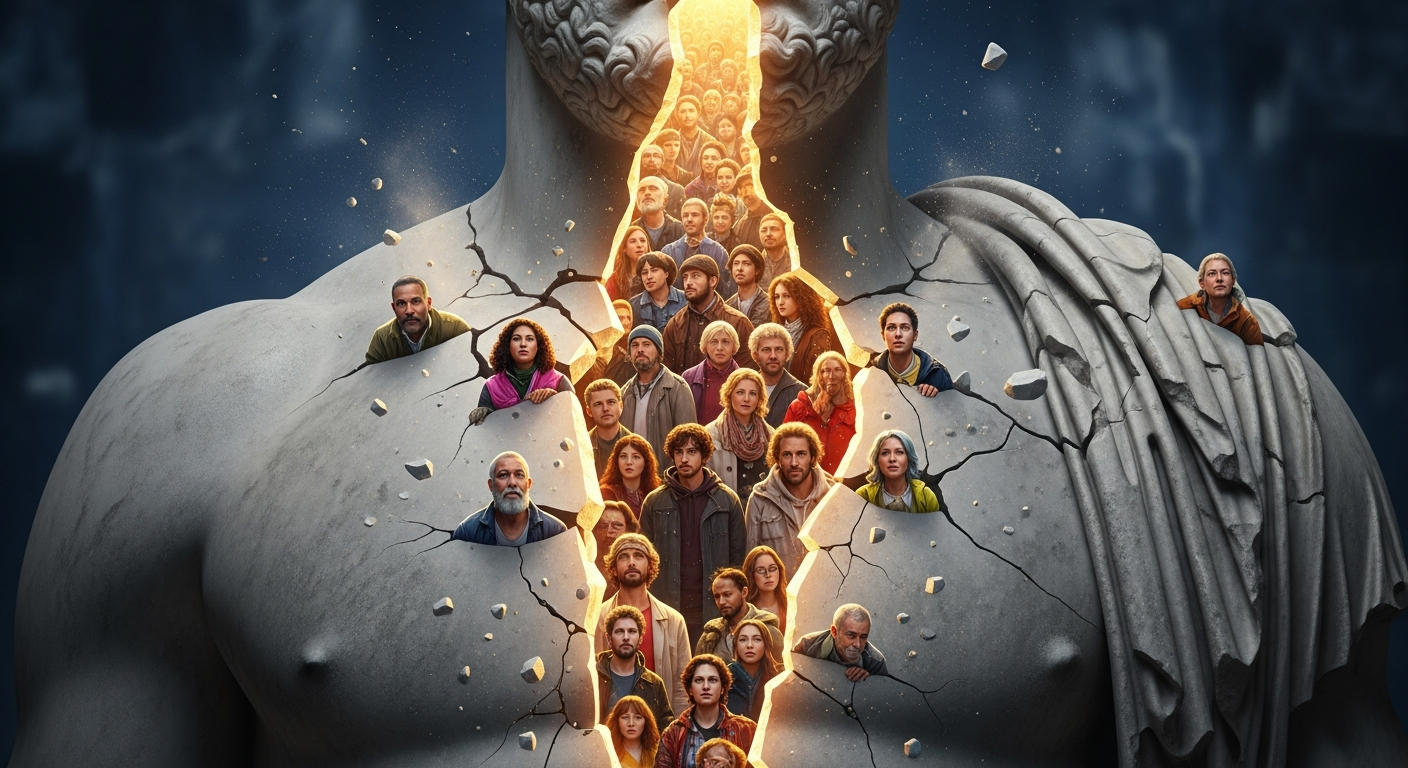
Anti-Essentialist: Let me name what’s been in the room this entire debate. The “human essence” you’re defending traces directly back to Aristotle — a man who explicitly argued that women possess reason in a “deliberative” but incomplete form, and that certain people are “slaves by nature,” suited to serve those with fuller rational capacity. He wasn’t an outlier applying essentialism badly. He was its most systematic architect, applying it consistently. The doctrine of fixed human essence, from its very origin, was used to declare certain categories of human beings less than fully human. That’s not a bug in essentialism’s history. It’s the inevitable output of the logical structure: define the essence, and those who don’t fit the definition are deficient.
Essentialist: That’s Aristotle’s limitation, not essentialism’s logic! Modern essentialism doesn’t carry those exclusions. We’ve corrected those errors.
Anti-Essentialist: “We’ve corrected those errors” — do you hear how that sentence works? It means the essence gets revised whenever the current version produces results we find morally unacceptable. Seventeenth century: indigenous peoples excluded as insufficiently rational. Nineteenth century: women excluded as governed by emotion rather than reason. Twentieth century: gay people excluded as against “human nature.” Every generation says “that was the wrong essentialism; ours is the corrected version.” The pattern is the problem. Whoever holds the power to define the essence holds the power to exclude. That’s not a historical accident. That’s the structure.
Round 9: AI Personhood — Can a Machine Be Human? #
Essentialist: Consider artificial intelligence. No matter how sophisticated an AI becomes — no matter how fluently it mimics thought, how accurately it predicts human responses — it lacks the one thing that grounds human essence: subjective experience. The felt quality of consciousness. Pain that actually hurts. Joy that actually elates. That phenomenal dimension is what makes a human life matter morally. An AI has none of it. The line holds.
Anti-Essentialist: How do you know? You cannot directly verify that another human being has subjective experience either — the problem of other minds is philosophically unsolved. You infer consciousness in other humans from behavioral and physiological similarity to yourself. As AI systems become more sophisticated in their behavior and — potentially — in their internal states, on what principled basis do you deny them the inference you extend to humans? A severely disabled person who cannot communicate their inner experience is still granted full moral consideration. If the criterion is “displays behavior consistent with inner experience,” then some AI systems may eventually qualify. If the criterion is “has a biological brain,” then you’ve abandoned the philosophical argument and replaced it with substrate chauvinism.
Round 10: The Turn — From “Is” to “Ought,” and a Final Agreement #
Essentialist: I’ll concede one thing. The specific content of human essence has been distorted, weaponized, and revised throughout history. I accept that critique. But the fact that humans share something in common — some basis for the claim that all human beings deserve equal consideration — cannot be abandoned. Reject the essence and you lose the foundation of human rights. “All humans are equal in dignity” — what grounds that claim if there’s no human nature it’s grounded in?
Anti-Essentialist: You’ve made a significant move. You’ve shifted from “essence is” to “essence must be.” From a descriptive claim to a normative one. And I’ll tell you exactly what I think about that shift. Human rights are not discovered — they are invented. The Universal Declaration of Human Rights in 1948 was not the uncovering of a natural law. It was a covenant, hammered out by exhausted people in the ashes of history’s worst war, deciding together what kind of world they refused to accept. It was a choice. That makes it more fragile. But it also makes it more honest.
Essentialist: If it’s just a choice — if it’s just a social agreement — then the next generation can unmake it. That terrifies me. Rights that depend on consensus can be voted away.
Anti-Essentialist: Yes. And that’s precisely why we cannot be complacent. The moment you believe rights are written into the fabric of nature, you stop fighting for them. You assume they’ll hold. Things we consider natural don’t require active defense. Only invented things need to be protected. The fragility is the argument for vigilance, not against it.
Essentialist: …I surrender the claim that essence is. I cannot surrender the conviction that it must be — that we need to act as though it exists, even if we can’t prove it does. Without that conviction, I don’t see how humans find a reason to protect each other.
Anti-Essentialist: I’ll accept that. “It is” and “it must be” are different sentences. One makes a factual claim. The other makes a commitment. And I can respect a commitment, even one I don’t share the metaphysical basis for. Today, for the first time, we agree on something.
Final Scorecard #
| Criterion | Essentialist | Anti-Essentialist |
|---|---|---|
| Logical rigor | 7 | 9 |
| Use of evidence | 7 | 9 |
| Counter-argument precision | 7 | 9 |
| Rhetorical force | 8 | 8 |
| Philosophical depth | 8 | 9 |
| Turning-point impact | 8 | 7 |
| Total | 45 | 51 |
Final Winner: Anti-Essentialist
The decisive blow landed in Round 8. The historical record of essentialism — from Aristotle’s exclusion of women and slaves to successive centuries of the same structural move applied to different target groups — exposed not a misapplication of the doctrine but its logical consequence. The Essentialist’s retreat to normative rather than descriptive claims (“it must be” rather than “it is”) was philosophically honest, but it conceded the central argument. The Anti-Essentialist’s acceptance of that normative stance in closing gave the debate an unexpectedly generous ending.
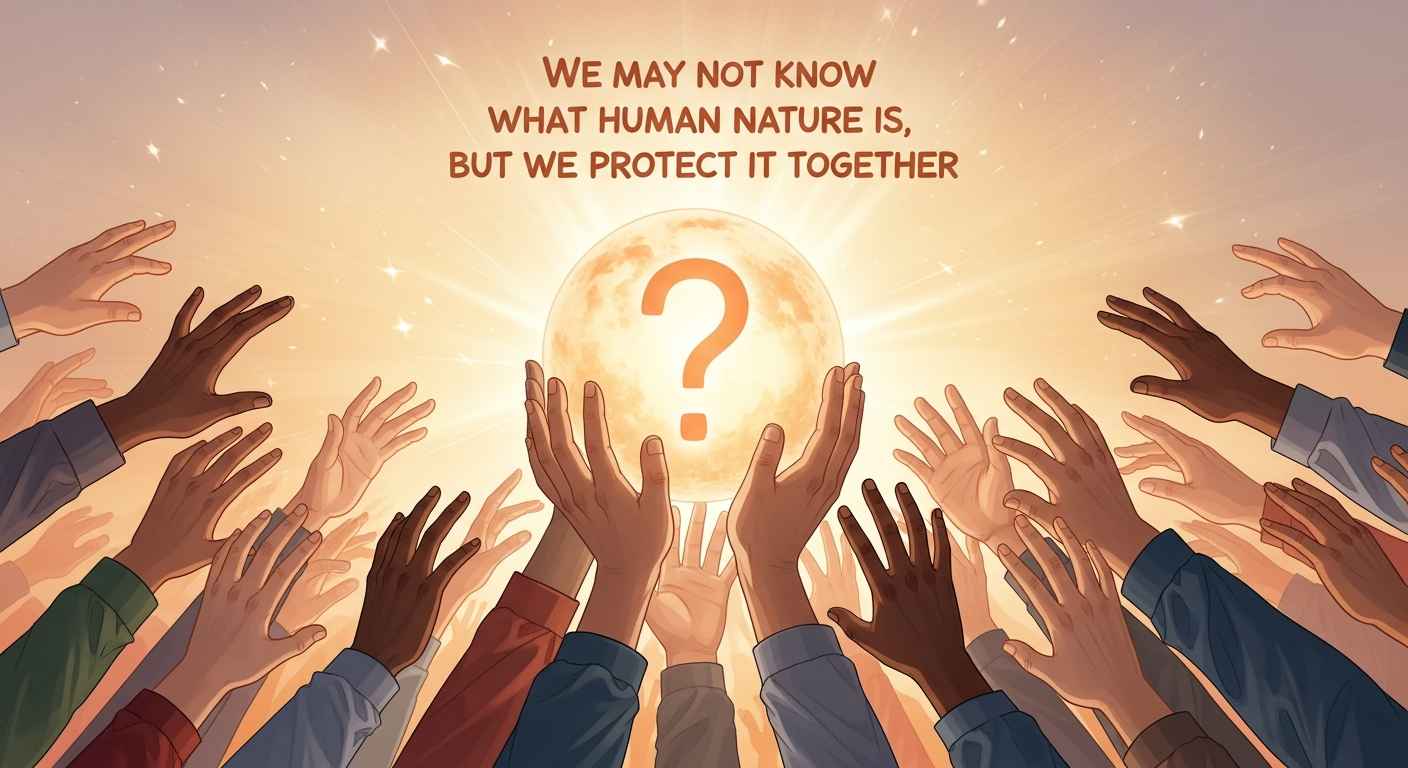
Human essence is not fixed. History proves this — not as an argument but as a record of constant redefinition, and a record of who paid the price each time the definition changed.
What remains, then? Not the certainty that essence exists, but the commitment to act as though dignity does. Human rights are not written into nature. They are a covenant we renew, or fail to renew, in every generation. That fragility is not a flaw in the design. It is the design — a reminder that the work of being human is never finished.
What is a human? Perhaps the most honest answer is: the kind of being that keeps asking the question, and refuses to stop.