
Look at the screen in front of you right now. Are you certain it’s real? What if this entire world — every sensation, every memory, every thought you’re having at this moment — is running on someone’s server somewhere, and even your doubt has been scripted?
Two thinkers face each other across a table. The Simulation Affirmatist comes armed with probability theory, quantum mechanics, and computational physics. The Simulation Skeptic fights back with Popper, phenomenology, and Occam’s Razor. The question cannot be proven or disproven. That, it turns out, is the most interesting part.
Round 1: Opening Gambit — Bostrom’s Trilemma #
Affirmatist: Nick Bostrom’s simulation argument gives us a trilemma — exactly one of these three propositions must be true. First: virtually all civilizations at our level of development go extinct before reaching the computational power needed to run ancestor simulations. Second: technologically mature civilizations simply choose not to run such simulations. Third: we are almost certainly living in a computer simulation right now. If you believe human civilization has a reasonable chance of surviving and that advanced civilizations would find simulated worlds interesting — and both seem plausible — then the third option becomes mathematically near-certain. One base reality. Potentially billions of simulations running in parallel. The probability you’re in the original? Astronomically small.
Skeptic: You want to resolve a question about the nature of existence using probability calculus? Karl Popper’s criterion: a hypothesis that cannot be falsified is not science — it’s mythology. The simulation hypothesis is an elegant story dressed in technical vocabulary. It’s theology for people who find God too old-fashioned and want a programmer instead. You’ve given me a probability argument for something we have no means of testing, verifying, or disproving. That’s not an argument. That’s a bet.
Round 2: Occam’s Razor #
Skeptic: Occam’s Razor — don’t multiply entities beyond necessity. The hypothesis “this world is real” fully explains everything we observe. The hypothesis “this world is a simulation running inside a larger reality” adds an entire undetectable layer of existence without explaining anything that the simpler hypothesis doesn’t. How is that different from medieval theology? You’ve replaced God with a programmer and called it physics.
Affirmatist: You’re misapplying the razor. Occam’s principle says don’t add unnecessary assumptions — but if quantum mechanics itself points toward a computational structure, then “simulation” isn’t an extra assumption, it’s the most parsimonious explanation of observed phenomena. Before a particle is measured, it exists in superposition — its state is indeterminate until observed. That’s structurally identical to a game engine that only renders the areas a player is actively looking at. The universe conserves computational resources exactly like a program optimizing rendering cycles. Simulation isn’t adding an entity. It might be the simplest explanation for why physics looks the way it does.
Round 3: Planck Length and Pixels #
Affirmatist: Here’s the physical argument. The Planck length — 1.616 × 10⁻³⁵ meters — is the smallest meaningful unit of space. Below this scale, the concepts of distance and spacetime break down entirely. Ask yourself: why does a supposedly continuous physical universe have a minimum resolution? Why does space have a smallest unit at all? In information theory terms, a universe with a minimum unit of space is a digital universe. Digital means discrete. Discrete means encoded. The pixel of reality is staring us in the face.
Skeptic: That’s not physics — that’s analogy cosplaying as physics. The Planck length is the scale at which our current theories break down, not necessarily the scale at which reality becomes discontinuous. Conflating “our models stop working here” with “reality has pixels” is a category error. And from a phenomenological standpoint — consider what you’re actually experiencing right now. The warmth of the air on your skin. The specific weight of this moment’s anxiety or curiosity. Merleau-Ponty argued that embodied experience — the living body’s encounter with the world — is the irreducible ground of all knowledge. Can you reduce that to binary code?
Round 4: The Mandela Effect — Glitches in the Database #
Affirmatist: The Mandela Effect. Millions of people sharing identical false memories — Nelson Mandela dying in prison in the 1980s, the Monopoly Man wearing a monocle, Pikachu’s tail having a black tip. Individual memory errors don’t produce this pattern of collective convergence. But if the simulation’s database gets patched — if certain historical records get updated while some memory caches aren’t refreshed — you’d get exactly this: widespread, consistent misremembrances that feel absolutely certain. We’re not misremembering. The patch notes just didn’t reach everyone.
Skeptic: Cognitive psychology explains the Mandela Effect far more cleanly than simulation theory. Collective memories cross-contaminate through social networks; confirmation bias amplifies false certainty; Elizabeth Loftus’s decades of research demonstrate how reliably human memory can be implanted and distorted at scale. You have a well-tested, falsifiable, neurologically grounded explanation available. Choosing “database patch” over “memory is reconstructive” requires a reason beyond “it fits the metaphor.” The simpler explanation wins on every criterion.
Round 5: Déjà Vu and the Loop #
Affirmatist: What about déjà vu? That overwhelming, inexplicable certainty that you’ve lived through this exact moment before — a situation you’re definitely experiencing for the first time. The standard explanation is a neural timing glitch in memory processing. Fine. But consider the alternative: if a simulation periodically resets certain segments, or rolls back state to an earlier checkpoint, the residual imprint of the previous run might persist in some corner of the system. Déjà vu as a ghost of the last loop. The echo of a reset.
Skeptic: Déjà vu has a well-documented neurological basis — it can be artificially induced in patients with temporal lobe epilepsy through targeted brain stimulation. We know the mechanism. It’s a timing desynchronization between parallel memory processes. For déjà vu to count as simulation evidence, you’d need to explain why a competent simulator would leave that artifact in its rendering — why the loop’s memory isn’t fully cleared. Your simulator has too many bugs for something built by a civilization advanced enough to simulate an entire universe.
Round 6: NPC Theory — Is Anyone Else Actually Conscious? #
Affirmatist: Consider the NPC problem. In any complex game, the vast majority of characters are non-player — scripted behavioral loops with no inner experience. The philosophical zombie problem — Chalmers’ thought experiment about beings behaviorally identical to conscious humans but with no inner experience — has never been solved. You cannot verify that the people around you are genuinely conscious rather than sophisticated automatons. In a simulation, only a small number of entities might be fully instantiated with genuine subjective experience. The rest are high-quality NPCs. The hard problem of consciousness gets a structural explanation.
Skeptic: Stop there. That argument is ethically catastrophic. The conclusion of “people around me might be NPCs” is “my actions toward them carry no moral weight if they’re not real.” That’s not an interesting philosophical puzzle — it’s the cognitive structure of every atrocity ever committed by people who decided their victims weren’t truly human. And philosophically: the fact that other minds are unverifiable is a problem that exists completely independently of simulation theory. Simulations don’t solve the hard problem of consciousness — they just relocate it one level up. Now the programmer has the consciousness problem.
Round 7: Religious Parallels — God vs. Programmer #
Affirmatist: The structural parallels between simulation theory and religious cosmology are hard to dismiss. An omniscient, omnipotent creator who designs and sustains reality, who exists outside the observable universe, who set the laws of physics — this describes both the God of theology and the programmer of simulation theory. The difference is that simulation theory grounds the argument in computational possibility and probabilistic reasoning rather than faith. It’s the same metaphysical architecture with better engineering.
Skeptic: You’ve just handed me the strongest argument against your position. The simulation hypothesis faces exactly the same epistemic problems that have made religious cosmology contested for centuries: unverifiability, unfalsifiability, explanatory regress. Who made the programmer? What is their reality like? You’ve solved nothing — you’ve pushed the mystery one level up and called it progress. And religion has delivered millennia of ethics, meaning-making, and community infrastructure. What does simulation theory offer? “Everything might be code” — and then what? What do you do with your Tuesday afternoon differently?
Round 8: The Turn — Falsifiability Cuts Both Ways #
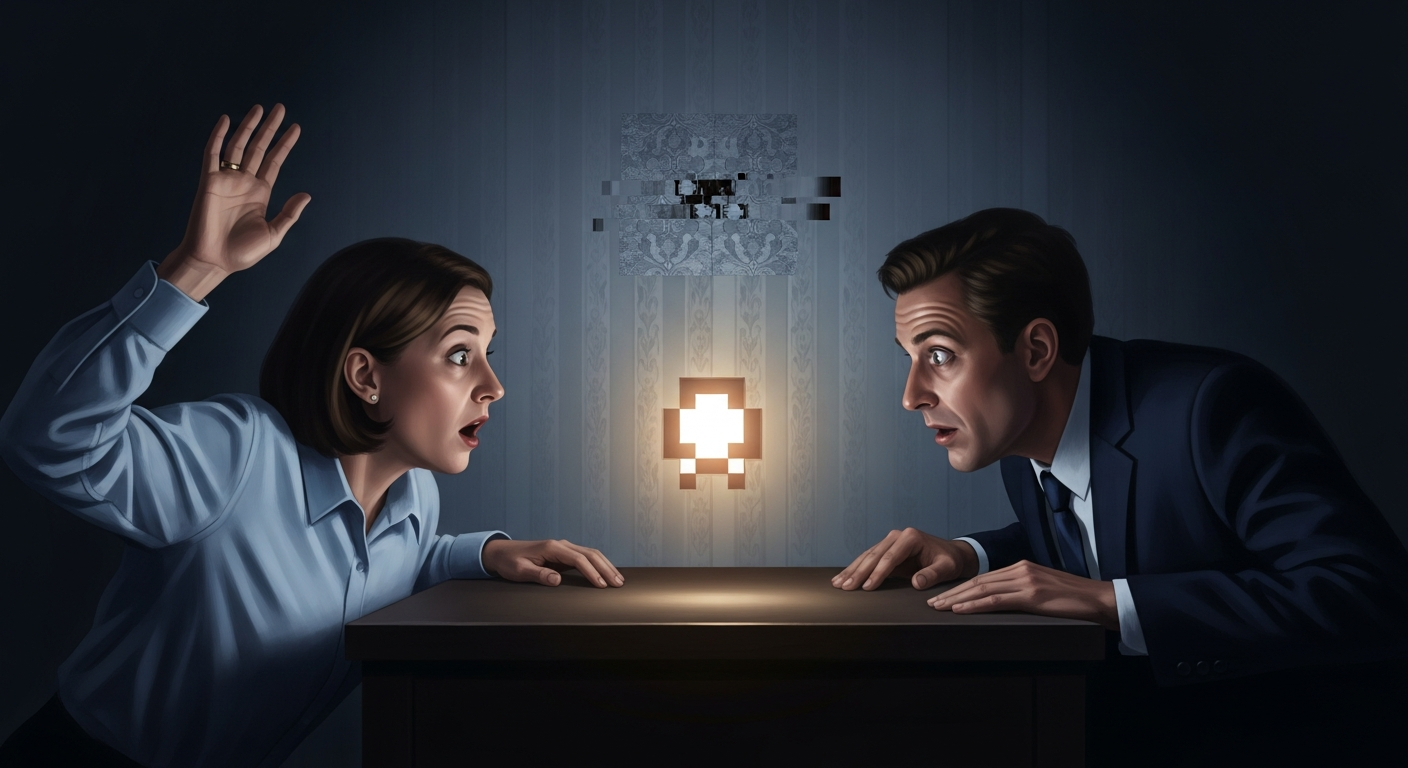
Affirmatist: You keep attacking the unfalsifiability of simulation theory. But here’s the decisive point: dreams feel real while you’re in them. VR induces genuine physiological responses — elevated heart rate, fear, physical sensation. A sufficiently perfect simulation would be undetectable from the inside by design. The absence of detectable seams isn’t evidence against simulation — it’s exactly what a perfect simulation would look like. You can’t use “I can’t detect it” as a refutation of something that, if true, would be undetectable.
Skeptic: Dreams end when you wake up. This world doesn’t end.
Affirmatist: It doesn’t end because you can’t end it. Perfect containment is the design spec.
Skeptic: …I have to be honest. I cannot prove this is not a simulation. I’ve been wielding Popper’s falsifiability criterion as a weapon, but I just walked into my own trap: “this world is real” is equally unfalsifiable. My own epistemological standard cuts down my position just as cleanly as yours. My logic has turned against me.
Round 9: “So What?” — The Question of Meaning #
Affirmatist: You’ve conceded the logical ground. So let’s press the conclusion. Elon Musk puts the odds of base reality at one in billions. Neil deGrasse Tyson said he’d give it fifty-fifty. The mathematical case is as strong as it gets for a philosophical hypothesis. We are almost certainly in a simulation.
Skeptic: Grant it entirely. So what changes? The grief I feel is real. The people I love are real to me. The moral weight of my choices doesn’t evaporate because the substrate might be computational. Cypher in The Matrix chose the simulated steak over the real world’s cold truth — and he wasn’t entirely wrong about the phenomenology. If the steak tastes good, it tastes good. The experience has weight regardless of what it’s made of. If I’m a pattern running on code, I’m still a pattern that suffers and hopes and tries to be decent. The simulation hypothesis doesn’t touch any of that.
Affirmatist: …I can’t refute that. Whether simulated or not, this moment is the only reality we have access to.
Round 10: The Resolution — What Matters More Than Proof #
Skeptic: Let me propose a conclusion we can both live with. Simulation or not, this is epistemically undecidable — we are equally ignorant on both sides. But the undecidability itself is the interesting finding. It means our confidence about the nature of reality should be a great deal more humble than it usually is.
Affirmatist: Agreed. The real gift of the simulation hypothesis isn’t the answer — it’s the destabilization. It forces you to ask: what are you taking for granted about the nature of existence? The universe is stranger than our intuitions suggest. That strangeness should produce wonder, not paralysis.
Skeptic: And wonder is what philosophy runs on. Not certainty.
Affirmatist: In the end: what matters isn’t whether it’s real. What matters is what you do with it.
Skeptic: That’s the only sentence we’ve both agreed on today.
Final Scorecard #
| Criterion | Simulation Affirmatist | Simulation Skeptic |
|---|---|---|
| Logical rigor | 8 | 8 |
| Use of evidence | 9 | 7 |
| Counter-argument precision | 8 | 8 |
| Rhetorical force | 8 | 7 |
| Philosophical depth | 8 | 8 |
| Turning-point impact | 8 | 9 |
| Total | 49 | 47 |
Final Winner: Simulation Affirmatist (conditional)
The decisive moment was Round 8. When the Skeptic acknowledged that “this world is real” is equally unfalsifiable to “this world is a simulation,” the logical advantage shifted decisively. However, the Skeptic’s existential counter-attack in Rounds 9–10 — that the simulation hypothesis changes nothing about the weight of lived experience — was philosophically compelling enough to make the overall margin narrow. Logical edge: Affirmatist. Philosophical depth: even.
The simulation hypothesis cannot be proven or disproven. That is the only certainty this debate produced.
But that uncertainty doesn’t license nihilism. If anything, the symmetrical unknowability of both positions — “it’s real” and “it’s simulated” are equally unfalsifiable — should produce a peculiar form of liberation. The foundation you stand on is uncertain. So you have to decide, freely and without cosmic warranty, what kind of person to be while standing on it.
The question isn’t whether reality is real. The question is what you’ll do with it either way. That question has always been the only one that matters.