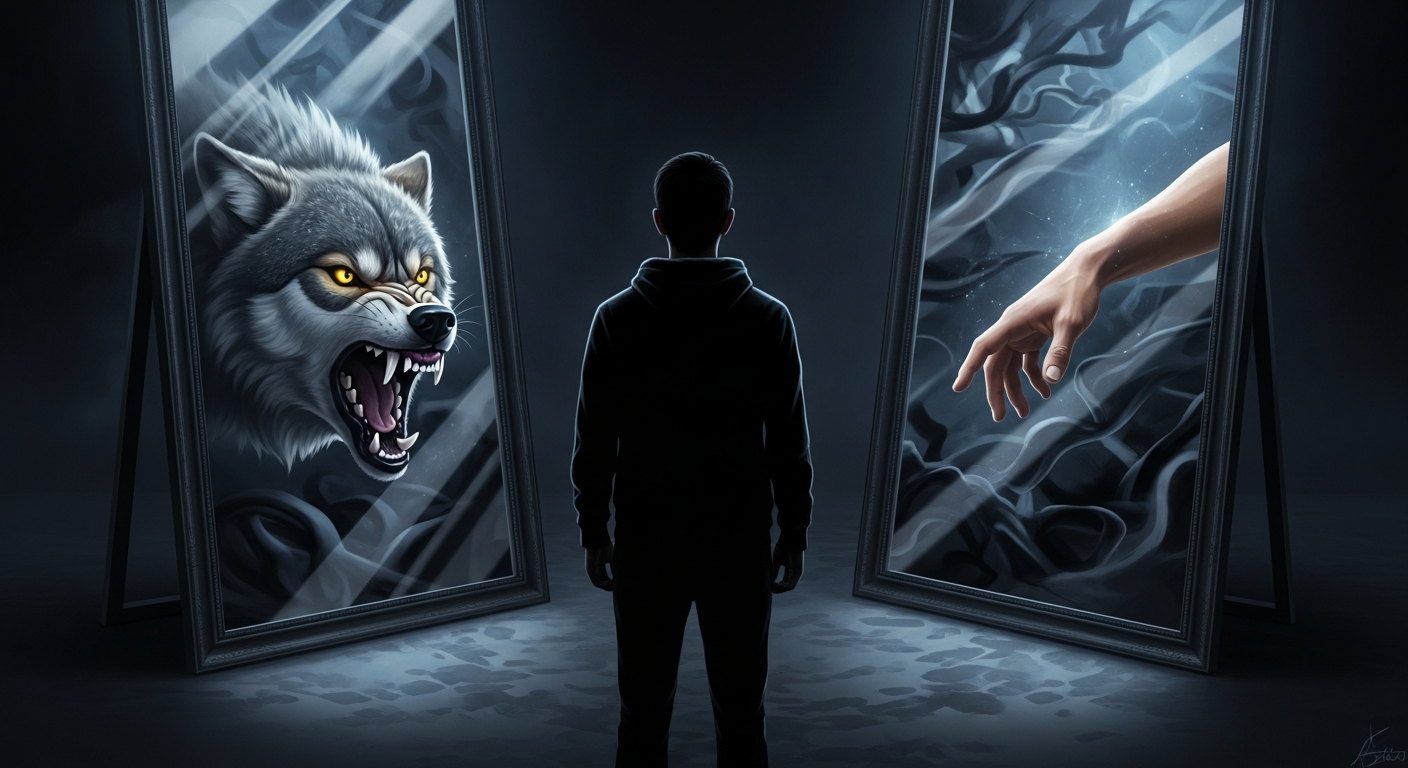
When was the last time you helped someone? And were you truly, purely motivated by their wellbeing alone?
Two figures sit across a table. One carries Hobbes and Dawkins on their back — the Selfish Nature Advocate. The other wields Levinas and Peter Singer as weapons — the Altruism Defender. The question is deceptively simple: Is human nature fundamentally selfish or altruistic? Ten rounds. No time limit. Philosophical combat.
Round 1: Opening Strike — The Naked Truth of Human Nature #
Selfish Nature Advocate: Hobbes was clear: the natural state of humanity is the war of all against all. Strip away law, government, social contract — what remains is survival at any cost. When you hand a dollar to a homeless person on the street, that’s not compassion. You’re purchasing the emotional satisfaction of feeling like a good person. You’re buying self-congratulation for a dollar.
Altruism Defender: By that logic, firefighters who run into burning buildings are just adrenaline addicts? Levinas argued that the moment you encounter another person’s face — truly encounter it — you feel responsibility before any conscious calculation begins. A mother who instinctively throws herself between her child and danger isn’t running a cost-benefit analysis. That reaction precedes thought. Calling it “self-interest” doesn’t explain it — it just labels it and moves on.
Round 2: The Genetic War #
Selfish Nature Advocate: Have you read Dawkins’ The Selfish Gene? A mother bird that performs a distraction display — dragging her wing to draw a predator away from her nest — looks heroic. But she shares 50% of her genes with each chick. From the gene’s perspective, risking one body to save several gene-copies is straightforward arithmetic. Everything that looks like altruism is just the selfish gene executing its survival strategy through us.
Altruism Defender: Then explain adoption. Parents who spend decades raising a child with whom they share zero genetic material — the selfish gene theory collapses entirely there. And Peter Singer’s research on effective altruism documents thousands of people donating significant portions of their income to strangers in other countries. There is no genetic overlap between a software engineer in San Francisco and a child dying of malaria in sub-Saharan Africa. None. Show me the gene’s calculation in that transaction.
Round 3: The Anatomy of Motivation #
Selfish Nature Advocate: Psychological egoism handles this cleanly. Even the generous donor is ultimately avoiding the discomfort of guilt — the pain of not giving. Pain avoidance is the root of all motivation. Anonymous donations are the purest form of this: you’re reinforcing your internal narrative of yourself as a moral person. You’re managing your self-image. That’s the whole story.
Altruism Defender: The moment you can explain every possible human action as selfishness — generosity is selfish, cruelty is selfish, sacrifice is selfish — your theory has become unfalsifiable. That’s not science. That’s a definitional trick. More importantly, neuroscience has shown that empathy circuits operate independently from reward circuits. The brain’s response to witnessing another person’s pain fires before any reward expectation registers. The compassionate reaction precedes the self-interested calculation. That sequencing matters enormously.
Round 4: The Weight of History #
Selfish Nature Advocate: Beautiful theory. Now look at the world. Wars, colonial exploitation, climate inaction — human history is a chronicle of selfishness. Nations invade for resources. Corporations poison rivers for profit. Individuals drive SUVs while knowing what it costs the planet. Cooperation? It’s just competing self-interests in temporary alliance, held together until the incentive structure shifts.
Altruism Defender: History cuts both ways. How did a species of 150-person tribes become an eight-billion-person civilization? Not through selfishness — through cooperation on a scale unprecedented in biology. You can’t build a language through selfishness alone. You can’t construct a hospital, develop a vaccine, or write a legal code if every participant is only maximizing personal gain. Martin Nowak demonstrated mathematically that cooperation is evolution’s third fundamental principle, alongside mutation and natural selection. The wars you cite are real. But they exist against a background of billions of daily cooperative acts that you’re choosing not to count.
Round 5: The Prisoner’s Dilemma #
Selfish Nature Advocate: Game theory settles this. In the Prisoner’s Dilemma, the rational actor always defects. Whether your partner cooperates or betrays you, defecting is the dominant strategy — it produces a better outcome for you in either scenario. This is the mathematical proof that selfishness is the logical engine of human behavior. Cooperation is sentimentality dressed up as strategy.
Altruism Defender: Except that when you run the experiment on actual humans, the math breaks down beautifully. In iterated Prisoner’s Dilemma tournaments, the highest-performing strategy was “Tit for Tat” — start with cooperation, then mirror your partner’s last move. Pure defection strategies lose over time. More striking: even in anonymous, one-shot versions of the game, humans cooperate far more often than the rational-actor model predicts. People routinely leave money on the table to avoid outcomes that feel unfair — even to strangers they’ll never meet again. The model of homo economicus doesn’t survive contact with actual humans.
Round 6: Corporate Social Responsibility #
Selfish Nature Advocate: Corporate Social Responsibility is the perfect illustration of my argument. When companies donate to charity or invest in sustainability, it’s a brand-building exercise — a calculated investment in consumer goodwill and employee retention. It’s selfishness in a philanthropist’s costume. “Good companies” are just companies that have discovered that ethics is profitable.
Altruism Defender: Then we need to separate motive from outcome. Even if a corporation acts ethically for self-interested reasons, the environmental protection or community support still happens — the altruistic result is real regardless of the impure motive. But your argument doesn’t hold even on motive: consider whistleblowers. People who expose corporate corruption, government fraud, or institutional abuse at enormous personal cost — they lose their jobs, their reputations, sometimes their freedom. Daniel Ellsberg. Edward Snowden. Sherron Watkins at Enron. The selfish calculus is clearly negative for all of them. Explain that with self-interest theory.
Round 7: The Anonymous Charity Paradox #
Selfish Nature Advocate: Even anonymous giving doesn’t escape the logic. The donor knows what they did. They’re reinforcing their own self-concept as a moral person — “I’m someone who gives without seeking recognition.” That private identity story is itself a form of self-satisfaction. The most anonymous gift is still a transaction with yourself.
Altruism Defender: Follow that argument to its conclusion and you’ve said nothing. Giving is selfish. Not giving is selfish. Acting with compassion is selfish. Acting with cruelty is selfish. A theory that can accommodate every possible human behavior without predicting or ruling out any of it has zero explanatory power. You’ve stretched the word “selfish” until it means “anything a human does.” That’s not an insight about human nature — it’s a linguistic sleight of hand. The real question is why some people, given the choice, consistently choose the option that costs them and benefits others. That pattern needs an explanation beyond “selfishness.”
Round 8: Empathy in Animals #
Selfish Nature Advocate: Drop down the evolutionary scale and altruism disappears. Lions kill cubs from rival prides. Chimpanzees conduct lethal raids on neighboring groups. Nature is red in tooth and claw, and that’s the baseline — the authentic signal beneath the civilized noise.
Altruism Defender: Frans de Waal spent decades documenting something different. Chimpanzees spontaneously help strangers obtain food they can’t reach. Rats — rats — will free a trapped cage-mate even when doing so means sharing or forgoing their own food. Elephants stand vigil over their dead for days. These behaviors have no obvious genetic payoff in the specific instances observed. De Waal’s argument is that empathy — the capacity to register another being’s distress as significant — is not a human invention. It’s an evolved capacity with deep roots in mammalian biology. If it’s the selfish gene driving all of this, then the selfish gene has chosen empathy as its preferred instrument. That’s a remarkable choice.
Round 9: Parental Sacrifice #
Selfish Nature Advocate: Parental sacrifice is the clearest case for kin selection. Hamilton’s Rule: an organism will sacrifice itself when the cost to the individual is outweighed by the benefit to genetic relatives, discounted by genetic relatedness. Parents protect children because children carry their genes forward. It’s the most elegant mechanism in evolutionary biology.
Altruism Defender: A mother in the terminal stage of cancer who refuses treatment she can’t afford so that the money goes to her children’s education. Her genes have already been transmitted. Hamilton’s Rule has completed its work — from the gene’s perspective, her continued survival offers diminishing returns. Yet she chooses. She chooses deliberately, knowingly, at enormous personal cost. And when you ask her why, she doesn’t say “genetic relatedness coefficient.” She says love. There is a gap between the evolutionary explanation and the experienced reality of that moment, and that gap is where human altruism actually lives.
Round 10: The Turn — The Act of Debating Itself #
Selfish Nature Advocate: …I have to be honest about something. Throughout this entire debate, I’ve wanted to win. I’ve been marshaling every argument I could find to defeat you. That’s selfishness in action — I’ve been demonstrating my own thesis in real time. But I realize now that’s about to collapse on itself. Because right now I’m choosing to tell you the truth instead of pressing my advantage. I’m abandoning the winning position to say something accurate. Is that… selfish?
Altruism Defender: That’s exactly it. In this moment — the moment you chose honesty over victory — you stepped outside self-interest. You gave up the thing you wanted, winning, for something that benefits the argument, truth, and therefore both of us and whoever is listening. That’s not a small thing. That’s the whole thesis made visible.
Selfish Nature Advocate: I concede. Humans are selfish — that part of my argument stands. But the capacity to recognize that selfishness, to feel its weight as a moral problem, to choose something different even when no one is forcing you — I can’t call that selfishness. I need another word for it.
Altruism Defender: The word is altruism. Imperfect. Inconsistent. Sometimes defeated by fear or greed or exhaustion. But real. Irreducibly real. And the fact that we keep reaching for it, even when we fall short — that reaching is everything.
Final Scorecard #
| Criterion | Selfish Nature Advocate | Altruism Defender |
|---|---|---|
| Logical rigor | 7 | 9 |
| Use of evidence | 8 | 9 |
| Counter-argument precision | 7 | 9 |
| Rhetorical force | 7 | 8 |
| Philosophical depth | 8 | 9 |
| Turning-point impact | 9 | 8 |
| Total | 46 | 52 |
Final Winner: Altruism Defender
The decisive moment came in Round 10. The Selfish Nature Advocate’s willingness to sacrifice victory for truth — to abandon a winning argument in favor of an honest one — enacted the very thing being debated. A selfishness theory cannot explain the behavior of someone who voluntarily undermines their own position in service of accuracy.
Humans are selfish. This is true. But humans are also capable of looking at their own selfishness, finding it insufficient, and choosing differently. That space of reflection — the gap between impulse and action — is where moral life happens. It’s where civilization is built, one deliberate choice at a time.
If selfishness is our starting point, altruism is the direction we choose to move. And direction, in the end, says more about us than origin ever could.