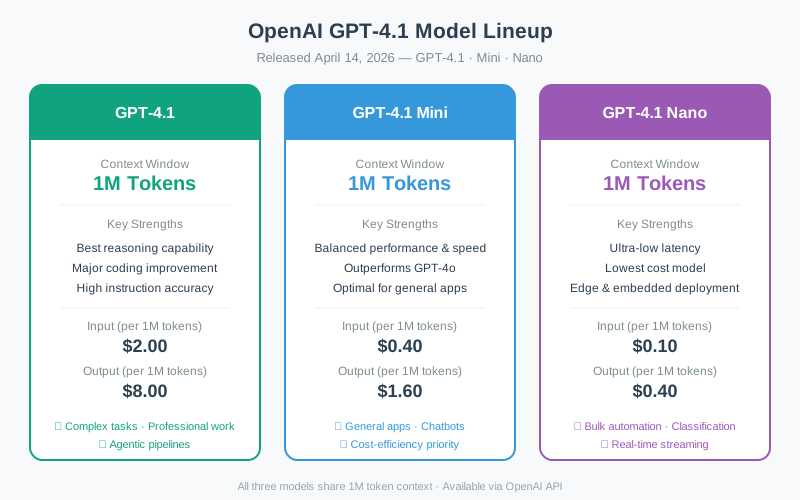
On April 14, 2026, OpenAI unveiled the GPT-4.1 series — three models comprising GPT-4.1, GPT-4.1 Mini, and GPT-4.1 Nano. This lineup immediately captured developer attention with dramatic improvements in coding ability and instruction following over its predecessor GPT-4o. Applying a 1-million-token context window across the entire lineup while significantly reducing prices are the headline differentiators.
Why GPT-4.1 Matters #
The GPT-4.1 series introduces three meaningful shifts to the AI ecosystem.
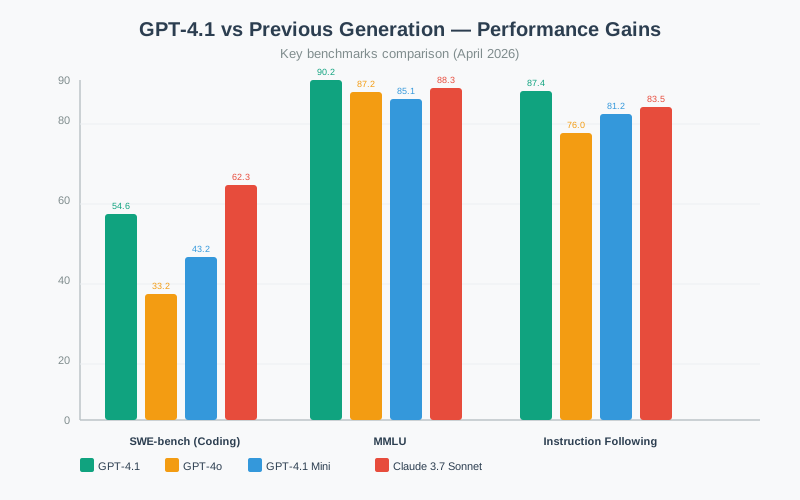
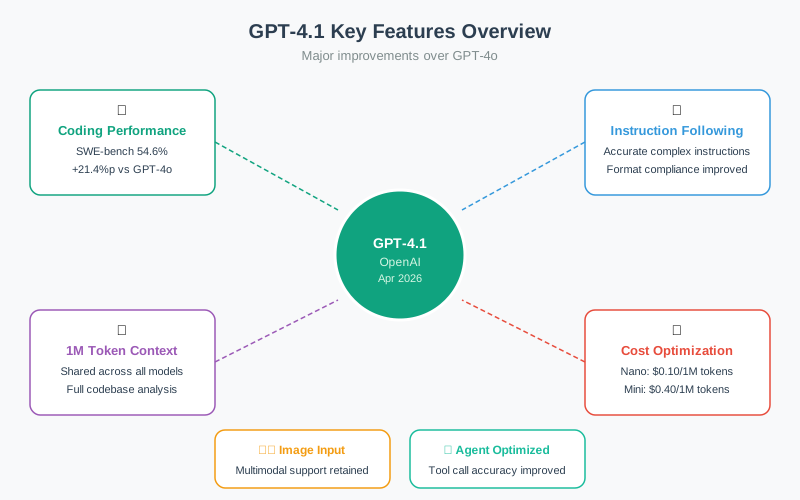
First, a breakthrough in coding ability. GPT-4.1 achieved 54.6% on SWE-bench Verified, up from GPT-4o’s 33.2% — a jump of 21.4 percentage points. This signals a rapid maturation in AI’s ability to autonomously solve real-world software engineering tasks: complex bug fixes, multi-file refactoring, and test generation all see tangible improvements.
Second, stronger instruction following. GPT-4.1 scores 87.4% on IFEval, demonstrating better adherence to long system prompts, complex multi-step instructions, and specific output format requirements. For production AI application developers, this translates into reduced prompt engineering overhead.
Third, 1M context applied across the entire lineup. The million-token context isn’t reserved for the flagship — Mini and Nano get it too. Large codebase analysis, long document processing, and sustained multi-turn conversations are now cost-effective at every price tier.
Per-Model Spec Comparison #
GPT-4.1 (Flagship) #
The most capable model in the series, suited for enterprise-grade tasks requiring complex coding, reasoning, and long-context understanding.
- Context window: 1,000,000 tokens (input), 32,768 tokens (output)
- Pricing: $2/1M input tokens, $8/1M output tokens (~26% cheaper than GPT-4o)
- SWE-bench: 54.6%
- MMLU: 90.3%
- Key strengths: Complex coding, agentic workflows, document analysis
GPT-4.1 Mini #
Mini balances cost and capability, delivering over 80% of the flagship’s performance at a fraction of the price.
- Context window: 1,000,000 tokens (input), 16,384 tokens (output)
- Pricing: $0.40/1M input tokens, $1.60/1M output tokens
- SWE-bench: 46.8%
- Key strengths: Fast responses, cost efficiency, general coding tasks
GPT-4.1 Nano #
Nano is the fastest and most affordable in the series, optimized for high-throughput processing, real-time applications, and edge deployments.
- Context window: 1,000,000 tokens (input), 8,192 tokens (output)
- Pricing: $0.10/1M input tokens, $0.40/1M output tokens
- Key strengths: Ultra-fast responses, large batch processing, classification and routing tasks
Benchmark Comparison Against Competitors #
GPT-4.1’s arrival has intensified competition at the top of the AI model landscape as of April 2026.
Coding Ability (SWE-bench Verified)
- GPT-4.1: 54.6%
- Claude 3.7 Sonnet: 62.3% (with Extended Thinking)
- Gemini 2.5 Pro: 63.8%
- GPT-4o: 33.2%
Gemini 2.5 Pro and Claude 3.7 still lead on SWE-bench, but GPT-4.1’s improvement over its predecessor is dramatic.
Instruction Following (IFEval)
- GPT-4.1: 87.4%
- Claude 3.7 Sonnet: 85.1%
- Gemini 2.5 Pro: 84.9%
GPT-4.1 edges ahead on instruction following — a practical advantage for production apps with complex prompting requirements.
Key Features Deep Dive #
Enhanced Multimodal Processing #
GPT-4.1 improves on GPT-4o’s vision capabilities, delivering better accuracy on technical diagram interpretation, UI/UX analysis, and chart data extraction. Tasks combining code and images — like identifying bugs from screenshots or converting Figma designs to code — show particularly notable gains.
Agentic Workflow Support #
GPT-4.1 shows substantially improved stability on multi-step agentic tasks. Tool-calling accuracy is higher, and consistency across long sequences of operations is better maintained. Paired with OpenAI’s Assistants API and Agents SDK, this makes GPT-4.1 well-suited for autonomous coding agents, research agents, and data analysis pipelines.
Real-Time Response Optimization #
Response latency is improved over GPT-4o, with Mini and Nano offering even faster output. Streaming API usage minimizes time-to-first-token (TTFT), enabling smooth interactive applications such as real-time chatbots and code autocomplete.
Practical Usage Guide #
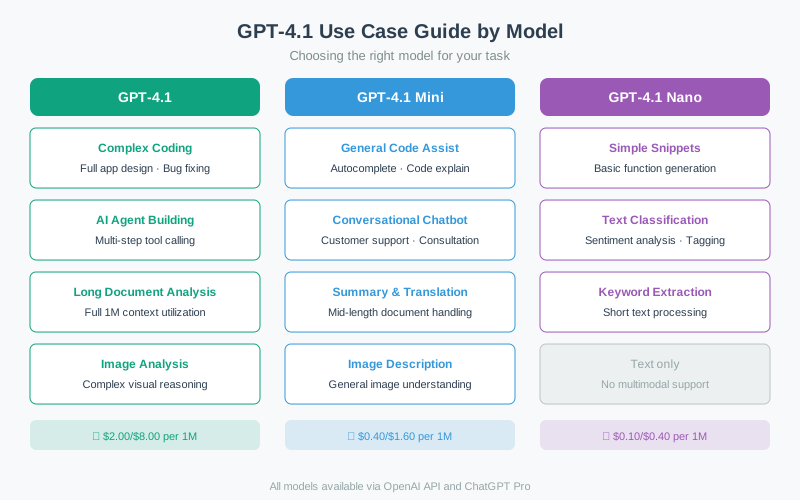
Which Model to Choose? #
Choose GPT-4.1 (Flagship) when:
- Refactoring or debugging large codebases
- Building complex multi-step agentic pipelines
- Performing enterprise document analysis requiring 1M token context
- Maximum quality output is required in production
Choose GPT-4.1 Mini when:
- General coding assistance and code review
- Mid-complexity chatbots and customer support
- Startup projects balancing quality and cost
- Running A/B tests against the flagship
Choose GPT-4.1 Nano when:
- High-volume simple tasks like text classification or sentiment analysis
- Real-time autocomplete or keyword extraction
- Side projects where cost is the top priority
- Edge or mobile apps requiring low latency
API Quick Start #
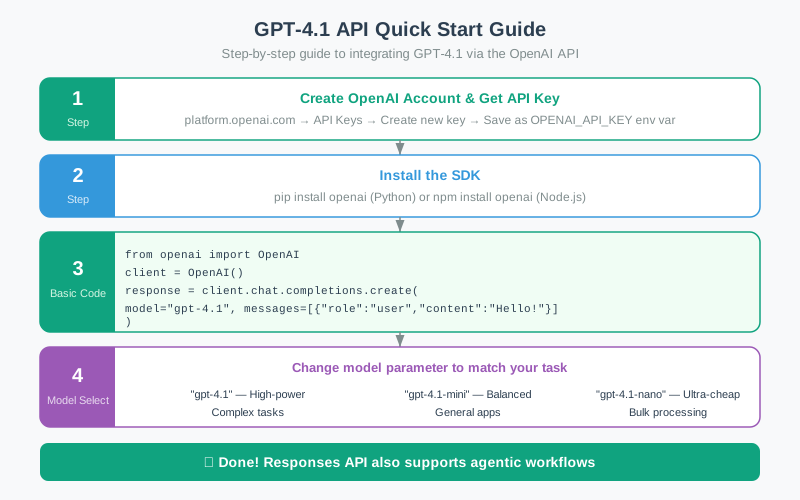
Basic API Call #
|
|
Streaming Responses #
|
|
Vision Capabilities #
|
|
Large Context Document Analysis #
|
|
Pricing Strategy and Cost Optimization #
The GPT-4.1 series is broadly cheaper than its predecessors. Mini and Nano unlock meaningful cost optimization based on workload type.
Cost reduction strategies:
- Prompt caching: Repeated system prompts benefit from caching — up to 50% savings
- Model routing: Auto-route simple queries to Nano, complex coding to the flagship
- Batch API: Non-real-time workloads get an additional 50% discount via Batch API
- Minimize output tokens: Design prompts that request only what’s needed, no filler
Real-World Project Ideas with GPT-4.1 #
Autonomous Coding Agent #
Leverage GPT-4.1’s high SWE-bench score to build an agent that automatically resolves GitHub issues. Combined with the OpenAI Agents SDK, the pipeline — issue analysis → code fix → PR creation — becomes fully automatable.
Automated Code Review #
Integrate GPT-4.1 into CI/CD pipelines to automatically review PRs on submission, detecting security vulnerabilities, performance bottlenecks, and style violations before human review.
Legacy Code Migration #
Use the 1M token context to migrate large legacy codebases to modern stacks: Python 2 → 3, jQuery → React, monolith → microservices. Process entire codebases in a single context window.
Auto-Documentation Generator #
Feed large codebases to Nano (cost-optimized) to auto-generate API docs, architecture overviews, and READMEs at scale.
Conclusion: GPT-4.1’s Positioning #
The GPT-4.1 series is designed with developer-friendliness as its primary goal within the OpenAI API ecosystem. The focused investment in coding ability and instruction following directly reflects what production AI application developers need most.
Gemini 2.5 Pro and Claude 3.7 hold advantages in certain reasoning domains, but GPT-4.1 counters with seamless OpenAI ecosystem integration (Assistants API, Agents SDK, ChatGPT), proven enterprise support, and broad third-party tool compatibility.
In AI tool selection, the question isn’t “which is the best model?” but “which model is best for my use case?” The GPT-4.1 series makes that choice richer.