In December 2024, Google announced that its new quantum processor — codenamed Willow — completed a calculation in just five minutes that would take the world’s fastest supercomputers 10²⁵ years to finish. That number is incomprehensibly large: it dwarfs the age of the universe by an astronomical margin. The announcement reverberated through the science and technology communities like nothing since the invention of the transistor.
To be clear, that benchmark did not solve a practically useful problem. But it was an unmistakable signal: quantum computing is transitioning from theoretical to tangible, from laboratory to real world, faster than most people expected. In 2026, quantum computing is no longer a distant future story. Right now, innovations that could transform drug discovery, financial modeling, cryptography, and artificial intelligence are moving from experiments to industrial applications.
What Is Quantum Computing? #
Understanding quantum computing starts with understanding how it differs from what we have today.
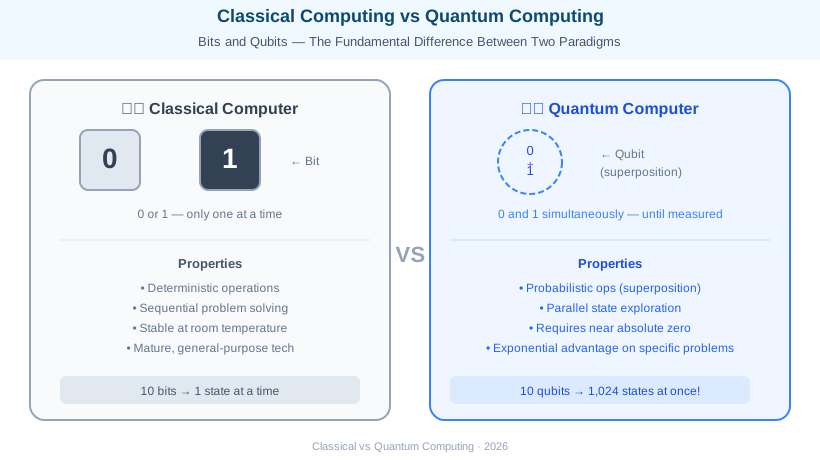
Every computer you’ve ever used operates on bits — the most fundamental unit of information. A bit can only be in one of two states: 0 or 1. Quantum computers use qubits (quantum bits) instead. Thanks to a principle called quantum superposition, a qubit can exist in a state of 0 and 1 simultaneously — like a coin spinning in the air before it lands. The value is only determined at the moment of measurement.
Why does that matter? While 10 classical bits can represent exactly one number between 0 and 1,023 at any given time, 10 qubits can represent all 1,024 possibilities simultaneously. As qubit counts scale up, this advantage grows exponentially.
The Three Core Principles of Quantum Computing #
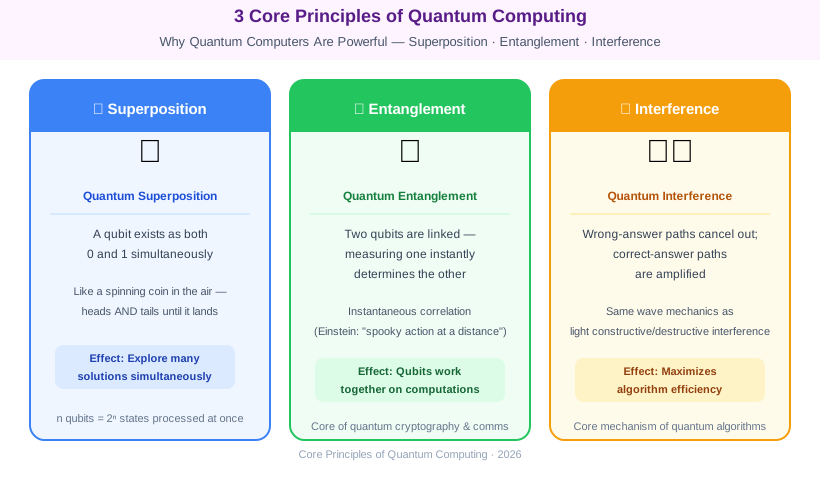
1. Quantum Superposition: A qubit’s ability to hold both 0 and 1 at the same time, enabling parallel exploration of many possible solutions simultaneously.
2. Quantum Entanglement: When two qubits are entangled, measuring the state of one instantly determines the state of the other — regardless of distance. This allows qubits to work together in coordinated ways impossible for classical bits.
3. Quantum Interference: The mechanism by which paths leading to wrong answers are cancelled out while paths leading to correct answers are amplified. This is what makes quantum algorithms more efficient than their classical counterparts.
The 2025–2026 Quantum Race: Who’s Winning? #
A fierce race for quantum supremacy is playing out among the world’s most powerful technology companies.
Google — Leader in Superconducting Qubits #
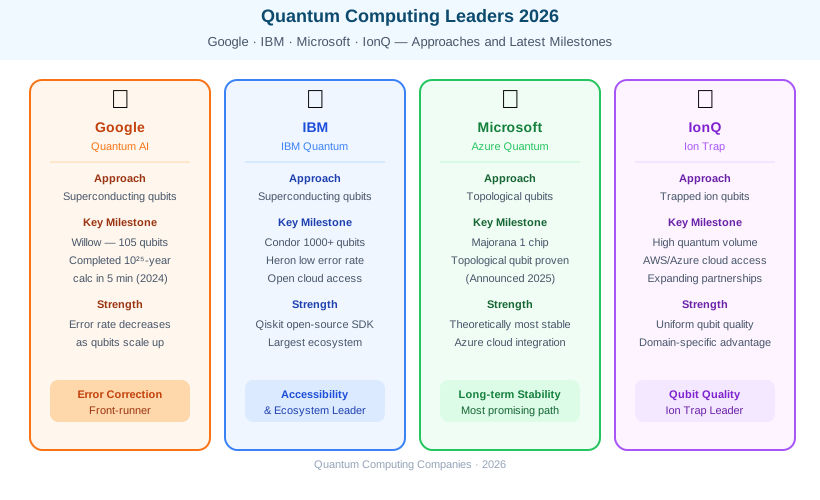
Google’s Quantum AI team unveiled its 105-qubit Willow processor in December 2024. The milestone wasn’t just the qubit count — it was something far more significant: for the first time, error rates decreased as the system scaled up. Previous quantum computers faced an intractable problem: adding more qubits introduced more errors, not fewer. Willow broke that fundamental barrier.
Google is now targeting a system of logical qubits — error-corrected and stable enough to tackle commercially meaningful problems — as its next major milestone for 2025 and 2026.
IBM — Champion of Accessibility and Ecosystem #
IBM’s quantum strategy centers on making quantum computing usable by everyone, not just physicists. In 2023, it unveiled the Condor processor with over 1,000 qubits, and in 2024 introduced the Heron processor, which dramatically reduced error rates. IBM’s cloud platform (IBM Quantum) opens real quantum hardware to anyone with an internet connection. Its open-source SDK, Qiskit, has been adopted by developers and researchers worldwide to experiment with quantum algorithms at scale.
Microsoft — Taking a Different Road with Topological Qubits #
Microsoft made a strategic decision decades ago to pursue an entirely different approach: topological qubits based on Majorana particles, rather than superconducting circuits or ion traps. In 2025, Microsoft validated this direction with its Majorana 1 chip, demonstrating that topological qubits are physically realizable. Topological qubits are theoretically far more stable, requiring far less error correction overhead. The path to practical deployment is longer, but the long-term potential is considered exceptional by many in the field.
IonQ — Precision Through Ion Traps #
Ion trap quantum computing manipulates naturally occurring atoms (ions) using lasers to implement qubits. Because every atom of the same element is physically identical, ion trap qubits are extremely uniform and stable. IonQ leads this approach: its machines have fewer qubits than superconducting competitors but higher quality (measured by quantum volume), giving it an edge in specific application domains.
Industries Quantum Computing Will Transform #
When quantum computing reaches practical scale, these are the industries where the impact will be felt first and most deeply.
Drug Discovery and Molecular Design #
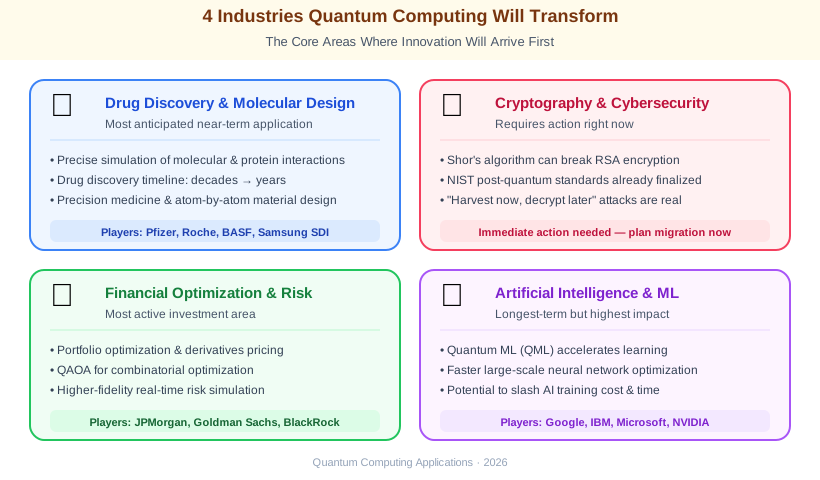
Simulating the quantum mechanical behavior of molecules — how they fold, interact, and react — is extraordinarily difficult for even the most powerful classical supercomputers. The computational requirements grow exponentially with the number of electrons involved. Quantum computers are naturally suited to this problem. The potential: compressing the drug discovery timeline from decades to years, enabling precision medicine, and designing new materials atom by atom.
Cryptography and Cybersecurity #
Today’s internet security relies largely on RSA encryption, whose strength rests on the difficulty of factoring the product of two large prime numbers. A sufficiently large quantum computer running Shor’s algorithm could break this in practical time, rendering current encryption obsolete. NIST has already finalized post-quantum cryptographic standards, and governments and financial institutions are racing to upgrade systems against the threat of “harvest now, decrypt later” attacks — where encrypted data is collected today to be decrypted once quantum computers mature.
Financial Optimization and Risk Management #
Portfolio optimization, derivatives pricing, and risk simulation are all fundamentally combinatorial optimization problems involving enormous numbers of variables. Quantum algorithms — particularly the Quantum Approximate Optimization Algorithm (QAOA) — can process these far more efficiently than classical methods. Major financial institutions are investing heavily in quantum capabilities for exactly this reason.
Artificial Intelligence and Machine Learning #
Quantum machine learning (QML) explores encoding training data into qubits to solve certain learning problems exponentially faster. Research suggests that quantum approaches to large-scale optimization — a core challenge in training neural networks — could dramatically reduce AI training costs and time. The full picture is still emerging, but the potential intersection of quantum computing and AI is one of the most watched areas in computer science.
Where We Actually Stand in 2026 #
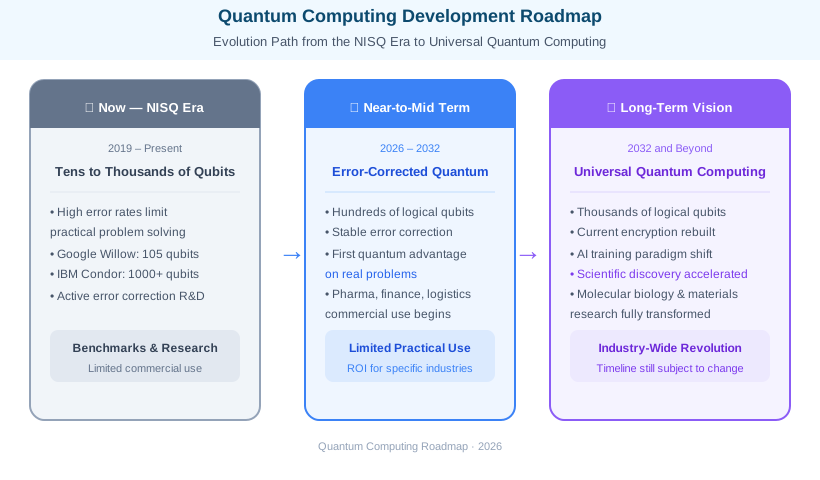
We are currently in the NISQ (Noisy Intermediate-Scale Quantum) era. Machines with tens to thousands of qubits exist, but high error rates make it difficult to reliably solve complex practical problems. Error correction requires encoding many “physical qubits” into one reliable “logical qubit” — and today’s ratio is still too costly to be practical at scale.
Near-term outlook (2026–2028): Expect the first demonstrations of genuine quantum advantage on practically useful (if still narrow) problems — particularly in chemistry simulation and optimization. This would be the first time quantum computers measurably outperform classical computers on something real-world clients actually need.
Medium-term outlook (2028–2032): Error correction improves enough to operate hundreds of stable logical qubits. Commercial applications in pharmaceuticals, finance, and logistics begin delivering measurable ROI. Cloud-based quantum services become standard offerings from major cloud providers.
Long-term outlook (2032 and beyond): Thousands of logical qubits enable fault-tolerant universal quantum computing. Encryption systems are fundamentally restructured. AI training accelerates. Scientific discovery — in materials, chemistry, and biology — operates at an entirely different pace.
It’s worth noting: these timelines have historically slipped. Engineering quantum systems at scale involves challenges that regularly surprise even experts. But the direction of travel is no longer in doubt.
What You Should Be Doing Now #
The full practical impact of quantum computing is still years away — but preparation starts today. In security particularly, data encrypted now could be harvested and decrypted later. Organizations handling sensitive long-lived data should be actively planning their migration to post-quantum cryptographic standards.
For developers and data scientists, now is the right time to build foundational fluency. IBM’s Qiskit and Google’s Cirq are mature, well-documented frameworks for experimenting with quantum circuits. Quantum computing is no longer the exclusive domain of physicists — it’s a field where software engineers and data practitioners will play central roles.
Google’s Willow completing in five minutes what would take classical computers longer than the age of the universe is not a party trick. It’s a preview. The age of quantum computing is beginning, and it will arrive faster than most people currently expect.