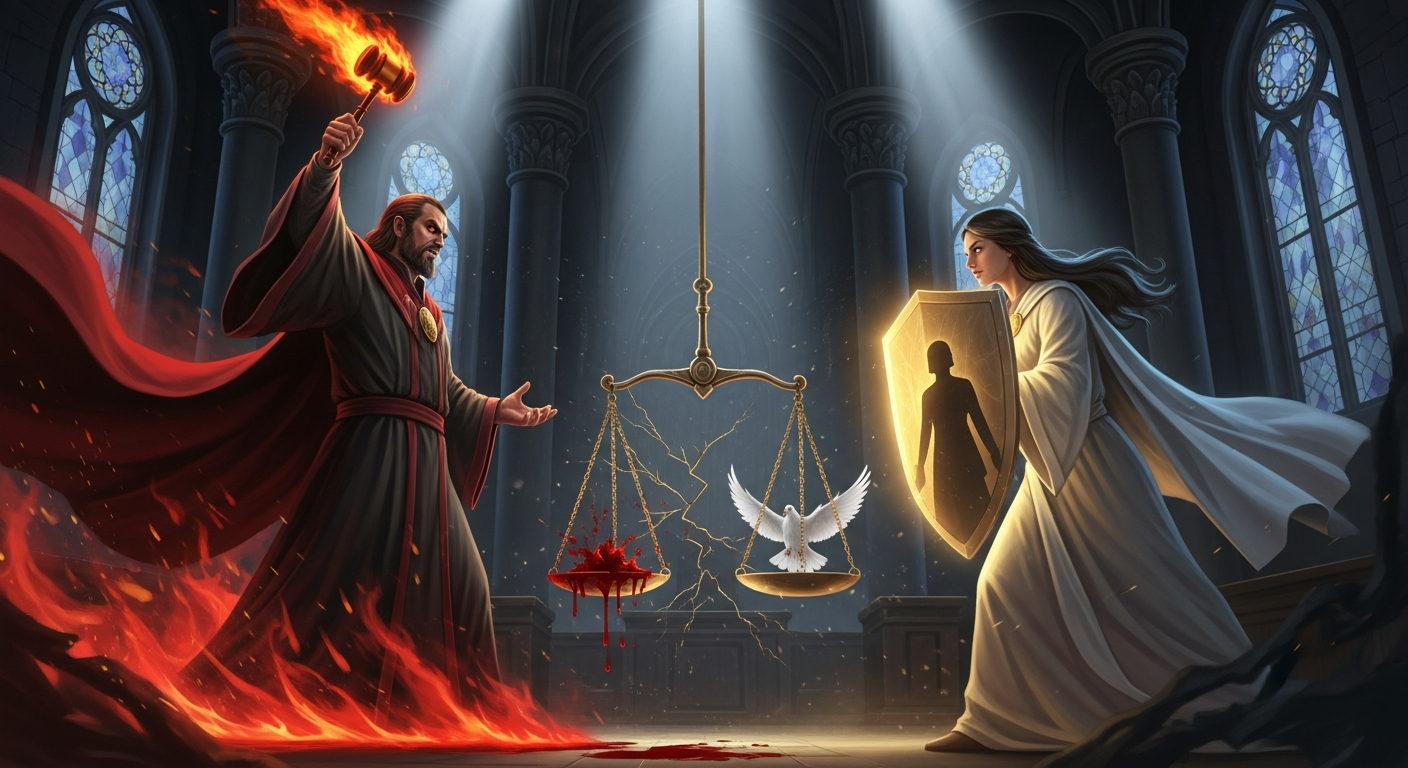
“Some crimes are so monstrous that only one punishment fits. But what if that punishment makes us monstrous too?”
Welcome to the ring. Two philosophies enter. One will be left standing — or at least, one will be left more shaken than when it arrived. In one corner: The Iron Judge — stern, data-armed, morally absolute, fighting for the proposition that justice demands a life for a life. In the other: The Guardian of Life — precise, relentless, armed with two centuries of abolition philosophy and a talent for finding the crack in every argument.
Ten rounds. The death penalty on trial. Let’s begin.
Round 1: The Opening — Kant’s Retribution vs. Kant Turned Against Himself #
The Iron Judge: “Let me be blunt. When a man looks another human being in the eyes and takes their life with premeditation, he has made a statement about the worth of human life. And Kant — Immanuel Kant, the philosopher every hand-wringing abolitionist loves to quote — agrees with me. In the Metaphysics of Morals, Kant wrote it plainly: ‘If he has committed murder he must die, because there is no substitute that will satisfy the requirements of legal justice. There is no likeness or proportion between life, however painful, and death.’ This isn’t barbarism. It’s mathematics. Rational, symmetrical, exact. The killer chose to treat a human being as a means to an end. Retributive justice demands we respond in kind — not out of hatred, but out of respect for the moral law.”
The Guardian of Life: “How convenient. You’ve quoted Kant in the first sixty seconds. Let me quote him back at you — same philosopher, different text. Groundwork of the Metaphysics of Morals, the one that actually defines his entire ethical system: ‘Act so that you treat humanity, whether in your own person or in that of another, always as an end and never as a means only.’ You want to use Kant to justify execution. But Kant’s categorical imperative cuts both ways. The moment the state straps a human being to a table and injects chemicals into his veins to end his life — the state is treating a human being as a means to a political end. As a demonstration. As a deterrent. As a message. You can’t borrow Kant’s respect for persons to demand the death penalty and then ignore Kant’s respect for persons when the needle goes in. That’s not philosophy. That’s cherry-picking a dead man’s words.”
Iron Judge: “Kant wasn’t contradicting himself. He was distinguishing between the criminal as a person — who retains dignity — and the criminal as a moral agent who has forfeited certain protections through his choices.”
Guardian: “Then you’re asking me to believe the state can honor someone’s dignity by killing them. That is a sentence I’d like you to read back to yourself slowly.”
Round 2: The Social Contract — “Broke the Deal” vs. “No One Signed Away Their Life” #
Iron Judge: “Fine. Let’s move to social contract theory, since you want to broaden the framework. Hobbes, Locke, Rousseau — the entire tradition agrees on one thing: society is a bargain. You surrender certain freedoms in exchange for protection. The murderer didn’t just break a law. He shattered the contract. He operated outside the bounds of civil society. And when you exit the contract, you exit its protections. Simple. You kill, you forfeit the right to life. Even Locke — hardly a bloodthirsty thinker — wrote that a murderer puts himself into ‘a state of war’ and can be destroyed ‘as a lion or a tiger, one of those wild savage beasts.’ The contract isn’t violated by execution. It’s enforced.”
Guardian: “Cesare Beccaria. 1764. On Crimes and Punishments. I’m going to give you a direct quote, since you seem to enjoy those: ‘Is it conceivable that the least sacrifice of each person’s freedom should include sacrifice of the greatest of all goods, life itself?’ Beccaria asked a devastatingly simple question: when citizens entered the social contract, did they give the state permission to kill them? They surrendered the right to kill others. They surrendered the right to steal, to assault, to defraud. But did any rational person sign over their own neck? Beccaria says no. I say no. And frankly, every liberal democratic constitution written in the last two hundred years agrees — which is why 55 countries have abolished the death penalty in law and practice since 1990 alone.”
Iron Judge: “Beccaria was an 18th-century pamphleteer writing for an audience that didn’t have to face serial killers, mass murderers, or terrorists.”
Guardian: “Beccaria was writing in a country with public executions, torture as standard procedure, and a criminal justice system so brutal it makes modern prisons look like spas. He wasn’t naive about violence. He just understood something you haven’t: that state violence doesn’t cancel private violence. It compounds it.”
Round 3: The Statistics War — Recidivism Rates vs. 190 Innocent Lives #
Iron Judge: “Let’s come down from the clouds of philosophy and talk about bodies. Real ones. A murderer who is executed cannot kill again. Recidivism data is brutal: released violent offenders reoffend at significant rates. In the United States, Bureau of Justice Statistics data shows that within nine years of release, over 80% of prisoners have been rearrested. You want to talk about irreversibility? How about the irreversibility of a second victim? A death row inmate who escapes, or who kills a prison guard, or who is released after a sentence reduction — that blood is on the hands of every person who decided his life was worth more than that victim’s safety. Permanent incapacitation is not cruelty. It’s certainty.”
Guardian: “You said recidivism. I’ll give you a more specific number. As of 2023, the Death Penalty Information Center has documented over 190 exonerations of death row inmates in the United States since 1973. One hundred and ninety human beings who were convicted, sentenced to die, and later proven innocent. Some came within days of execution. Some served decades on death row for crimes they didn’t commit. At least twenty people are believed to have been executed in the United States for crimes they didn’t commit. Twenty people killed by the state for nothing. You want to talk about recidivism and certainty? Here’s some certainty: your system kills innocent people. And unlike a prison sentence, you cannot undo an execution. There is no court of appeal that reaches across death.”
Iron Judge: “No system is perfect. Courts exist to minimize—”
Guardian: “‘No system is perfect’ is the most chilling defense of state killing I have ever heard. You’re describing an acceptable error rate — in human lives. How many innocent people is an acceptable number for you to execute? Three? Ten? Twenty? Give me a number. Put it on record.”
Iron Judge: “…That’s not—”
Guardian: “No answer? Then you’ve already lost this round.”
Round 4: Getting Personal — The Gloves Come Off #
Iron Judge: “You know what I find fascinating? Abolitionists always argue from statistics and philosophy. Clean hands, clear conscience, safe from consequences. I’d like to introduce you to reality: families of murder victims who have spent decades watching the killer who destroyed their world receive three meals a day, legal representation, appeals, conjugal visits, and university degrees — all on the taxpayer’s dime. You talk about Beccaria and Camus from a lectern. Try telling a mother whose daughter was tortured to death that the dignity of the killer is the paramount concern. Your philosophy is the philosophy of people who’ve never lost anything.”
Guardian: “That was low. And deliberately so, because you know your philosophical arguments are bleeding out, so you’ve pivoted to emotional blackmail. I am not dismissing victims’ pain. Their grief is real, catastrophic, and deserves genuine support — decades of genuine support, which most justice systems fail to provide because they’re too busy spending $1.26 million per death penalty case — the documented average in California — on prosecution and appeals, money that could fund victim counseling for years. But here’s what I’ll say directly: grief is not a philosophy of justice. Grief is grief. Understandable, human, devastating. But if we designed law around the worst moment of a victim’s family’s pain, we wouldn’t have a justice system. We’d have a revenge machine. And revenge is not justice. Hammurabi tried it. It didn’t civilize the world.”
Iron Judge: “Don’t lecture grieving families about Hammurabi.”
Guardian: “Don’t weaponize grieving families to avoid answering hard questions. They deserve better than being used as rhetorical shields.”
Round 5: International Comparison — The Company You Keep #
Guardian: “Let’s talk geography, since statistics are fair game. Currently, 106 countries have fully abolished the death penalty. Another 28 are abolitionist in practice. That’s a global majority. The countries that retain and actively use the death penalty as of the most recent data: China, Iran, Saudi Arabia, Egypt, the United States, Iraq, Somalia. That is the list. That is the company. Meanwhile, every Western European democracy — Germany, France, the UK, Sweden, Norway — abolished the death penalty decades ago. Their murder rates? Lower than the United States. Significantly lower. Norway’s homicide rate is roughly 0.5 per 100,000. The United States, with its executions, clocks in around 5 per 100,000. Ten times higher. If the death penalty deters murder, someone needs to explain Norway.”
Iron Judge: “Correlation isn’t causation. Norway has different demographics, different gun laws, different social safety nets, different—”
Guardian: “Exactly. Which means the death penalty is not the variable that explains lower crime rates. Which means it isn’t doing what you claim it does. Which means its primary justification — deterrence — is empirically unsupported. The National Research Council reviewed decades of studies in 2012 and concluded, explicitly, that existing research was fundamentally flawed and should not be used to inform judgments about the deterrent effect of the death penalty. Not inconclusive. Fundamentally flawed. Your deterrence argument doesn’t just lose this round. It doesn’t exist.”
Iron Judge: “I never led with deterrence. I led with retribution. Justice isn’t about deterrence — it’s about desert. What the criminal deserves.”
Guardian: “Then we’re back to my Kant argument from Round 1, and we both know how that ended.”
Round 6: The Irreversibility Argument — One Mistake, No Correction #
Iron Judge: “You’ve been circling back to the irreversibility point repeatedly. Let me give you credit: it’s your strongest argument. But you’re overstating it. Life imprisonment is also severe. Also life-altering. A man who spends 40 years in prison and is then exonerated — what exactly has he gotten back? You speak of reversibility as though a prison release makes a wrongful conviction whole. It doesn’t. The years are gone. The family relationships, the career, the health, the life that was never lived — all gone. The irreversibility of a wrongful prison sentence may be less final than death, but it is not dramatically more just. Both are catastrophic failures.”
Guardian: “I’ll grant you part of that. Wrongful imprisonment is a catastrophe. But notice what you just did: you argued that since imprisonment is also bad when wrongful, we might as well execute people. That is not an argument for the death penalty. That’s an argument for radical justice reform across the board. And I’m for that — fully, completely. But there remains an absolute, undeniable, categorical difference between a catastrophe you can partially address and a catastrophe you cannot address at all. Carlos DeLuna was executed in Texas in 1989. Decades of investigation later, researchers concluded the actual killer was a man named Carlos Hernandez. DeLuna’s family cannot be compensated. His execution cannot be reviewed. His name cannot be formally cleared by a living man walking out of prison. He is dust. The state turned a human being into dust based on a mistake. Prison, for all its horrors, leaves a door. Execution welds it shut.”
Iron Judge: “The cases are rare.”
Guardian: “Tell that to the 190.”
Round 7: Race and Class — Justice for Sale #
Guardian: “I want to talk about who actually ends up on death row. Because if the death penalty is the pure, clean expression of retributive justice you’ve described — symmetrical, rational, color-blind — the data should look random. It doesn’t. In the United States, a study by David Baldus found that defendants in Georgia were 4.3 times more likely to receive a death sentence if the victim was white than if the victim was Black. A separate analysis found race of the defendant and victim to be the most significant predictor of who gets sentenced to death. Furthermore: the quality of legal representation is the single strongest predictor of outcome in capital cases. Rich defendants get experienced counsel, expert witnesses, investigators. Poor defendants get overworked public defenders handling 100 cases at once. Your ‘rational retribution’ runs on racism and poverty. It doesn’t measure the crime. It measures the defendant’s bank account.”
Iron Judge: “Then the solution is to fix the biases in the system, not abolish the punishment itself. A corrupt scale doesn’t mean the concept of weight is wrong.”
Guardian: “A lovely metaphor. Here’s the problem: we have been trying to fix those biases since McCleskey v. Kemp in 1987, when the Supreme Court was presented with the Baldus study directly. The Court acknowledged the statistical evidence and ruled it wasn’t enough to overturn a sentence. They said racial disparity at a systemic level doesn’t constitute discrimination in an individual case. In other words: the Supreme Court of the United States looked at proof that the system is racist and said ‘so what.’ That was nearly forty years ago. The disparities persist. At what point does ‘fix the system’ stop being a plan and become a prayer? You don’t keep using a broken machine while promising to fix it when the broken machine is executing human beings.”
Round 8: The Crack #
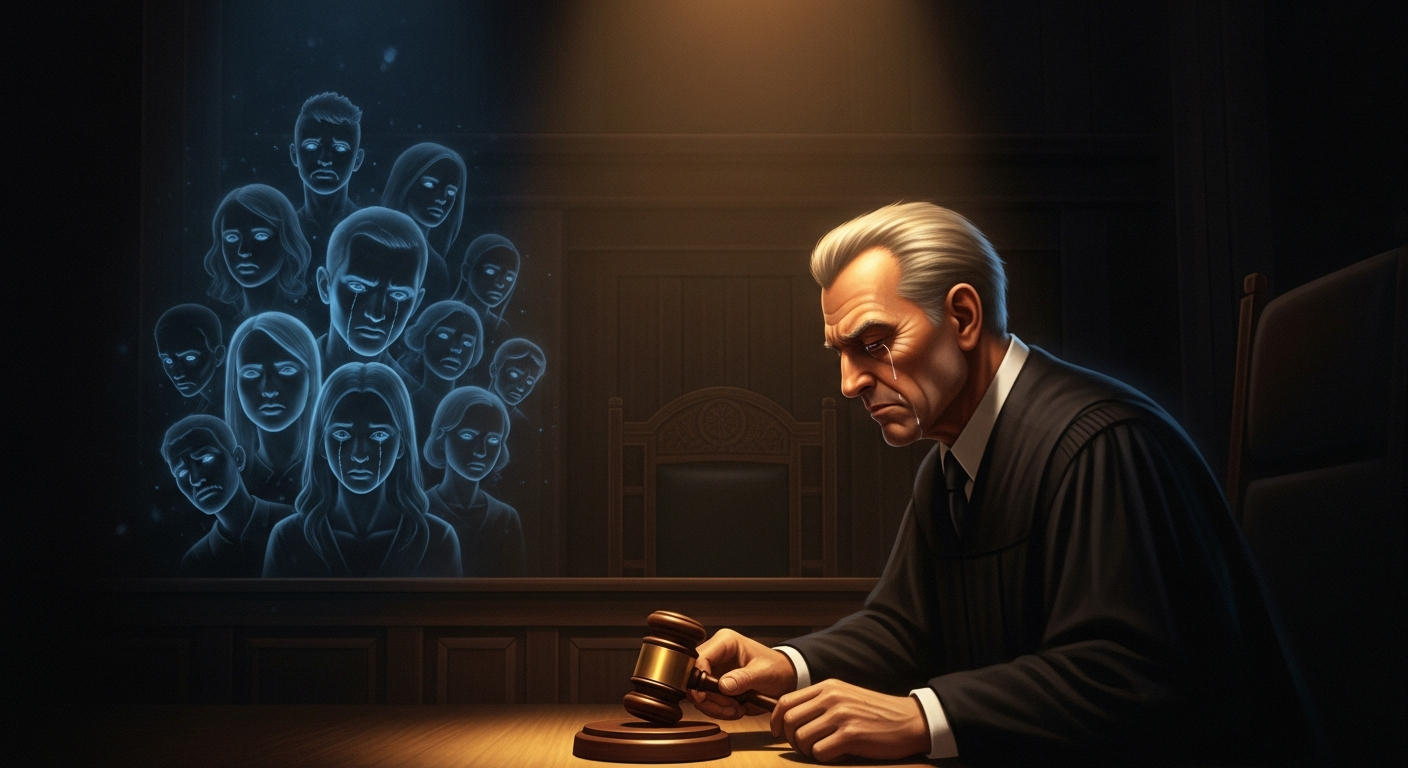
Iron Judge: (a beat of silence, longer than any before)
“I need to… stop. For a moment. Because there’s something I haven’t been fully honest about.”
Guardian: “I’m listening.”
Iron Judge: “I’ve been arguing this as a clean philosophical exercise. Kant, retribution, desert. The logic is airtight in the abstract. A life for a life. Moral symmetry. And I believe in that logic — I genuinely do. But the Baldus study is not an abstraction. Those 190 exonerations are not abstractions. And there’s something I keep running from in this debate: the fact that when I imagine the death penalty being just, I imagine it being applied to the worst of the worst. The most obvious cases. The most undeniable guilt. I imagine it being applied to people like me deciding, with confidence, who deserves it. But that’s not how it works. It works through a system made of human beings — tired prosecutors, biased juries, underfunded defenders, political pressures, racial histories. And I… I keep arguing for a theoretical ideal while the actual machine grinds away at reality. The ideal and the machine are not the same thing.”
Guardian: “No. They’re not.”
Iron Judge: “I still believe some crimes cry out for the ultimate response. I still think there are monsters who have forfeited their claim to mercy. But I can’t… I can’t fully square that belief with what you’ve shown me tonight. I don’t know if I can square it at all.”
Guardian: “That discomfort you’re feeling right now? That is not weakness. That is what moral seriousness feels like.”
Round 9: The Kill Shot #
Guardian: “So let me ask you something. Not a rhetorical trap — a genuine question. When the state looks at a human being and says you will die, and we will make it happen — who, exactly, is making that decision? Not in the abstract. In the room. In the process. A prosecutor who wants a conviction. A jury of twelve people with their own fears and prejudices. A judge whose career depends on looking tough. A governor who could commute a sentence but fears the political cost. A legislature that passed the law to signal values rather than to engineer outcomes. Which one of these human beings, with their human ambitions and human biases and human errors, do you trust to decide who deserves to die? Because the death penalty isn’t handed down by the moral law itself. It’s handed down by these people. Fallible, self-interested, occasionally corrupt, sometimes racist, usually overworked people. And here is what I want you to sit with: the moment you give any institution the power to decide who deserves to die, you have given human beings — with all their flaws — a power that cannot be safely given. Not because every executioner is evil. But because the power to kill is the power that most corrupts. And you know this already. That’s why you were silent just now.”
Iron Judge: “But without that power, what do you do with the irredeemable? The serial killer who enjoys it. The terrorist who’d do it again. Where does justice—”
Guardian: “Here is the final thing. The moment you decide who deserves to die, you have become the thing you claim to punish. You have taken a human life based on your judgment of its worth. That is exactly what the murderer did. You are not reenacting justice. You are reenacting the crime — with paperwork. And unlike the murderer, you cannot even claim passion, or fear, or madness. You are doing it deliberately, calmly, and in the name of civilization. Which means you have no excuse at all.”
Round 10: The Weight of It #
Iron Judge: “…I’m not going to tell you I’ve changed my mind completely. I still believe in the gravity of certain crimes. I still believe victims’ families deserve justice that means something — not just a number tattooed on a prison jumper. I still think there are cases where the word ‘justice’ seems too small for what was done.”
Guardian: “I’m not asking you to stop believing in justice. I’m asking you to ask whether this particular tool actually delivers it.”
Iron Judge: “Tonight — in this conversation — I cannot prove that it does. I can only say that the alternative feels incomplete. That life imprisonment for certain crimes feels like a sentence that doesn’t match the weight of the offense.”
Guardian: “And I would ask you: who told you that justice must match the weight of the offense by replicating it? An eye for an eye was a limitation in Mosaic law — a rule against excessive revenge, not a mandate for equivalence. ‘You may take no more than an eye’ was progress, not a standard. We have been moving away from equivalence for three thousand years. Every step of that movement was called weakness by people who thought it too gentle. Every one of those steps was, in retrospect, civilization.”
Iron Judge: “Perhaps. But the families—”
Guardian: “The families deserve everything. Everything we’ve failed to give them. Counseling. Support. Acknowledgment. Real resources. Time. What they don’t deserve is to have their pain used as the philosophical engine that justifies an irreversible act by a fallible system that we both now know is broken. They deserve better than being handed an execution as a substitute for healing.”
Iron Judge: (quietly) “I can’t argue with that. I don’t know if I agree with all of it. But I can’t argue with it.”
Guardian: “That’s enough. That’s all I asked.”
The Scorecard #
| The Iron Judge | The Guardian of Life | |
|---|---|---|
| Core Claim | Justice demands proportional punishment; murder deserves death | The state cannot be trusted with irreversible power over human life |
| Arsenal | Kant’s retributive justice, social contract theory, recidivism data | Beccaria, Camus, wrongful conviction data, racial disparity studies |
| Best Punch | “Recidivism is real — a dead man doesn’t reoffend” (R3) | “190 exonerations. Give me your acceptable error rate.” (R3) |
| Dirtiest Move | Weaponizing victims’ families to deflect philosophical critique (R4) | “The company you keep: China, Iran, Saudi Arabia, the US” (R5) |
| Fatal Flaw | Defends the theoretical ideal while ignoring the operational machine | Weaker on the emotional weight of the worst crimes |
| Turning Point | Round 8 — acknowledged the gap between ideal retribution and real systems | Round 9 — turned the admission into an unanswerable moral indictment |
| Emotional Arc | Stern → Aggressive → Data-driven → Cornered → Honest → Shaken | Precise → Sharp → Relentless → Devastating → Quietly Certain |
| Result | Undefeated in theory, unable to answer in practice | Victory — by moral attrition |
What This Debate Costs #
“The measure of a civilization is not how it treats its best citizens, but how it treats the worst.”
The death penalty debate is unlike most political arguments because the stakes are absolute. You cannot hedge. You cannot split the difference. Either the state can take a life, or it cannot. And once you look squarely at who that power falls on in practice — not in philosophy seminars, but in real courtrooms with real defendants and real jurors — you are forced to ask whether the machine we’ve built is capable of bearing the moral weight we’ve assigned to it.
The Iron Judge was not a fool. He was not cruel. He was a man who took justice seriously enough to fight for it. But he made the mistake every defender of capital punishment eventually makes: he argued for the ideal while the reality was doing the arguing against him.
Albert Camus wrote, in Reflections on the Guillotine, that capital punishment is the one punishment that “rejects the possibility of rehabilitation” — not because rehabilitation always happens, but because it removes the possibility before we can know. And possibility, he argued, is what distinguishes a justice system from an act of violence.
The Iron Judge couldn’t answer the question he was asked: how many innocent people is an acceptable price?
Not because he was dodging. Because there is no answer. Because any number — one, five, twenty — is monstrous. And a system built on a question with no acceptable answer is not a system of justice. It is a system of faith. Faith that this time, we got it right. Faith that the biases didn’t intrude. Faith that the lawyer was competent, the witness wasn’t lying, the jury wasn’t afraid.
That faith has been broken 190 times and counting.
Some questions don’t resolve. The death penalty debate leaves scars on everyone who takes it seriously — because it sits at the intersection of our deepest impulses: the need for justice, the terror of violence, the knowledge of fallibility, and the weight of finality. The Iron Judge walked in certain and left shaken. That’s not a failure. That’s what engagement with a real argument does to an honest mind.
The final question isn’t whether some crimes feel deserving of death.
It’s whether we are deserving of the power to decide.