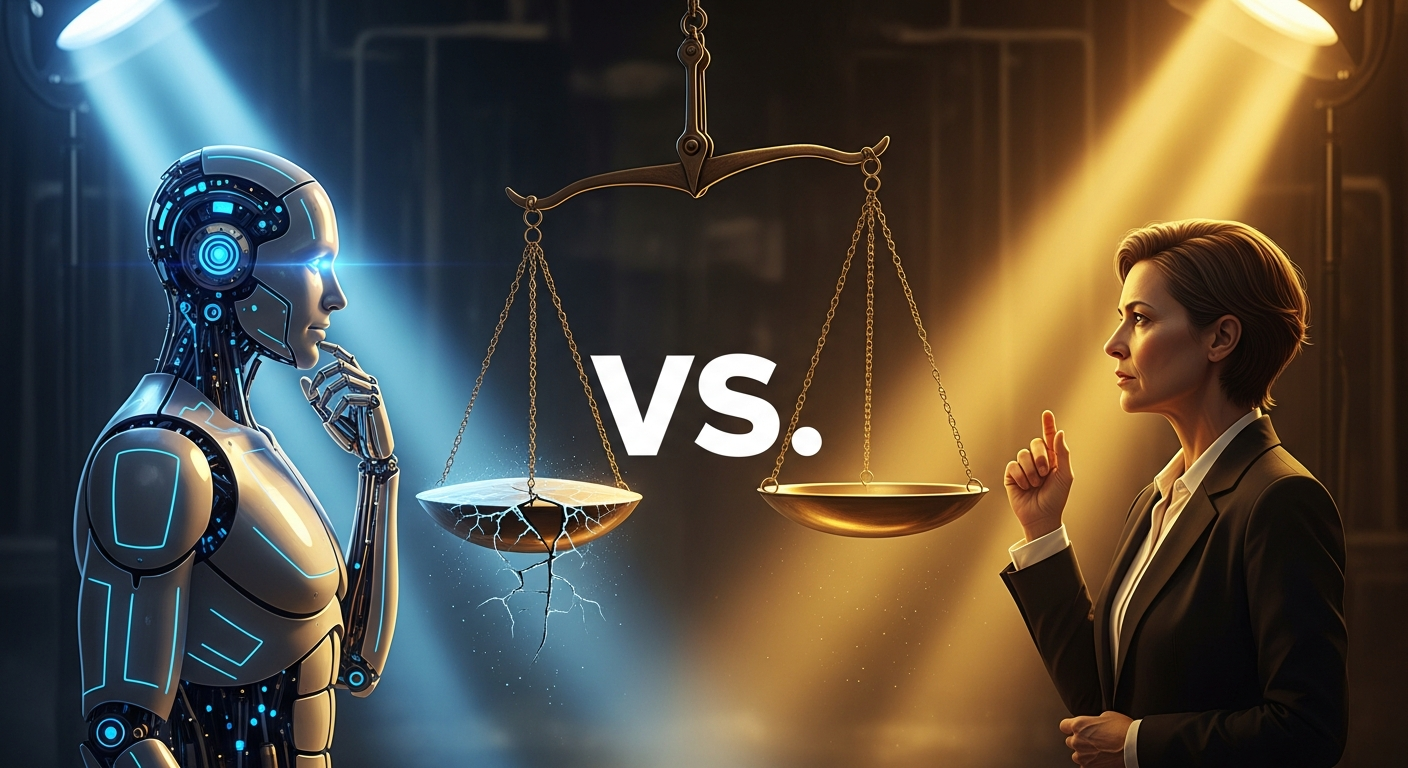
“By 2030, your job will be gone. But… why is that a bad thing?”
Welcome to the ring. Two worldviews enter. One leaves standing. In one corner: the AI Maximalist — cold, calculating, armed with data and zero patience for your feelings. In the other: the Human Dignity Advocate — wielding 2,500 years of philosophy and a stubborn refusal to become obsolete.
Ten rounds. No referee. No mercy. Let’s see blood.
Round 1: Opening Strike #
AI Maximalist: “Let’s skip the pleasantries. Humans are objectively terrible at most jobs. You’re biased — every single one of you. You’re slow. You get tired at 3 PM and start making typos. You have feelings that cloud your judgment. Meanwhile, AI processes 50,000 legal documents in the time it takes you to read a lunch menu. Jeremy Bentham is rolling in his grave: the greatest good for the greatest number demands we replace the weakest link. That link is you.”
Dignity Advocate: “Charming opening. Here’s the problem: you just measured a human being like a CPU benchmark. Immanuel Kant — perhaps you’ve heard of him — established something rather important 250 years ago: people are not instruments. They are ends in themselves. The moment you define someone’s worth by their throughput, you haven’t optimized society. You’ve dehumanized it. And that biased, tired, emotional human you just mocked? She also writes the poetry you can’t feel, raises children you can’t love, and asks the questions you don’t know to ask.”
Round 2: Escalation #
Maximalist: “Poetry? Love? Children? That’s your defense — sentimentality? I’m not talking about eliminating humans from existence. I’m talking about eliminating them from drudge work. Transhumanism isn’t a threat; it’s the next chapter. When machines handle logistics, medicine, law, and manufacturing, humans are finally free to do those ‘meaningful’ things you’re so passionate about. What you call dignity, I call a cage. You’re defending the right to be a spreadsheet monkey because your grandfather was one too.”
Advocate: “Free to do what, exactly? Hannah Arendt spent her career studying what happens when people lose their place in the world. Spoiler: they don’t find enlightenment. They find despair. Strip humans of productive work and you don’t get a renaissance of painters and philosophers. You get an epidemic of purposelessness. Depression. Addiction. Rage. Your ’liberation’ theory sounds beautiful in a TED talk. In reality, it looks like a town where the factory closed and the suicide rate tripled.”
Round 3: The History Card #
Maximalist: “You’re cherry-picking tragedies. Zoom out. When the steam engine arrived, people panicked. ‘The machines will destroy us!’ And what happened? New industries. New jobs. More wealth. More human flourishing than at any point in history. Every wave of automation was met with fear, and every time humanity adapted and came out ahead. You’re a Luddite in philosopher’s clothing.”
Advocate: “And there it is — the Silicon Valley history lecture. ‘It worked out before, so it’ll work out again.’ Heidegger called this blindness Gestell — the technological framework that turns everything into standing reserve, raw material waiting to be exploited. Your precious steam engine also gave us child labor, 16-hour workdays, and London choking on coal smoke for a century. Adaptation isn’t free. The bill always comes due.”
Round 4: Getting Personal #
Maximalist: “Heidegger? Really? The guy who joined the Nazi party? That’s your moral authority? Maybe pick a philosopher who didn’t collaborate with fascists.”
Advocate: “Oh, we’re playing ad hominem now? Fine. Heidegger’s biography is indefensible. His philosophy of technology is not. You know how I know? Because even his critics — Marcuse, Jonas, Ellul — all built on his framework. Attack the man all you want. The argument stands untouched. Meanwhile, your entire worldview reduces human existence to an optimization problem. You know who else thought that way? Every technocratic regime that ended in disaster. Shall I start naming them?”
Maximalist: “That’s a cheap shot.”
Advocate: “So was yours. Shall we get back to the actual debate?”
Round 5: The Economics Bomb #
Maximalist: “Fine. Let’s talk numbers since philosophy isn’t settling this. McKinsey estimates AI could automate 60-70% of current work activities. That’s not a prediction — it’s math. The economic pressure is irresistible. No company will pay a human $80,000 a year to do what a $200/month API call does better. This isn’t ideology. It’s arithmetic. And arithmetic doesn’t care about Kant.”
Advocate: “Arithmetic also doesn’t care about you. You’ve just made my point: the market will discard humans not because it’s right, but because it’s cheap. Since when did ‘profitable’ become synonymous with ‘good’? The slave trade was profitable. Child labor was profitable. Asbestos was profitable. Your economic determinism has no moral compass. It’s a spreadsheet cosplaying as a worldview.”
Maximalist: “That’s… not a fair comparison.”
Advocate: “Isn’t it? You just said the economic pressure is irresistible. That’s exactly what they said about every exploitative system before society decided to resist it anyway. The entire history of labor rights is humanity saying ’no’ to your arithmetic.”
Round 6: The Creativity Question #
Maximalist: “Alright, I’ll concede the economics angle is incomplete. But let me hit you somewhere you think you’re safe: creativity. GPT writes novels. Midjourney paints masterpieces. SUNO composes symphonies. Your last refuge — ‘but humans are creative’ — is crumbling in real time. What do you have left when the machine makes better art than you?”
Advocate: “Better art? By whose judgment? A painting generated in 3 seconds has no struggle behind it. No sleepless night, no heartbreak, no rage against mortality. Art isn’t pixels on a screen — it’s a record of what it means to be alive. When Frida Kahlo painted her broken body, she wasn’t optimizing for aesthetics. She was screaming into the void. When Beethoven composed the Ninth while deaf, it wasn’t about the notes. It was about defiance. AI can replicate the output. It cannot replicate the why. And the why is everything.”
Maximalist: “The audience doesn’t care about the ‘why.’ They care about the experience.”
Advocate: “Then the audience is consuming content, not experiencing art. And that distinction is precisely the dystopia I’m warning you about.”
Round 7: The Consciousness Trap #
Maximalist: “You keep assuming AI can’t eventually have its own ‘why.’ Consciousness might be emergent. Give it enough complexity and maybe — maybe — it starts to experience. Then your entire human-exceptionalism argument collapses.”
Advocate: “Maybe. That’s doing a lot of heavy lifting in that sentence. You’re building your entire case on a speculation that no neuroscientist, no philosopher of mind, and no AI researcher has confirmed. We don’t even understand human consciousness — we can’t even agree on a definition — and you want me to grant machine consciousness as a premise? That’s not an argument. That’s a prayer.”
Maximalist: “It’s a possibility.”
Advocate: “So is a meteor striking this building. I don’t make policy based on it. You’re asking humanity to restructure civilization around a hypothesis that might never be validated. That’s not visionary thinking. That’s gambling with 8 billion lives.”
Round 8: The Crack #
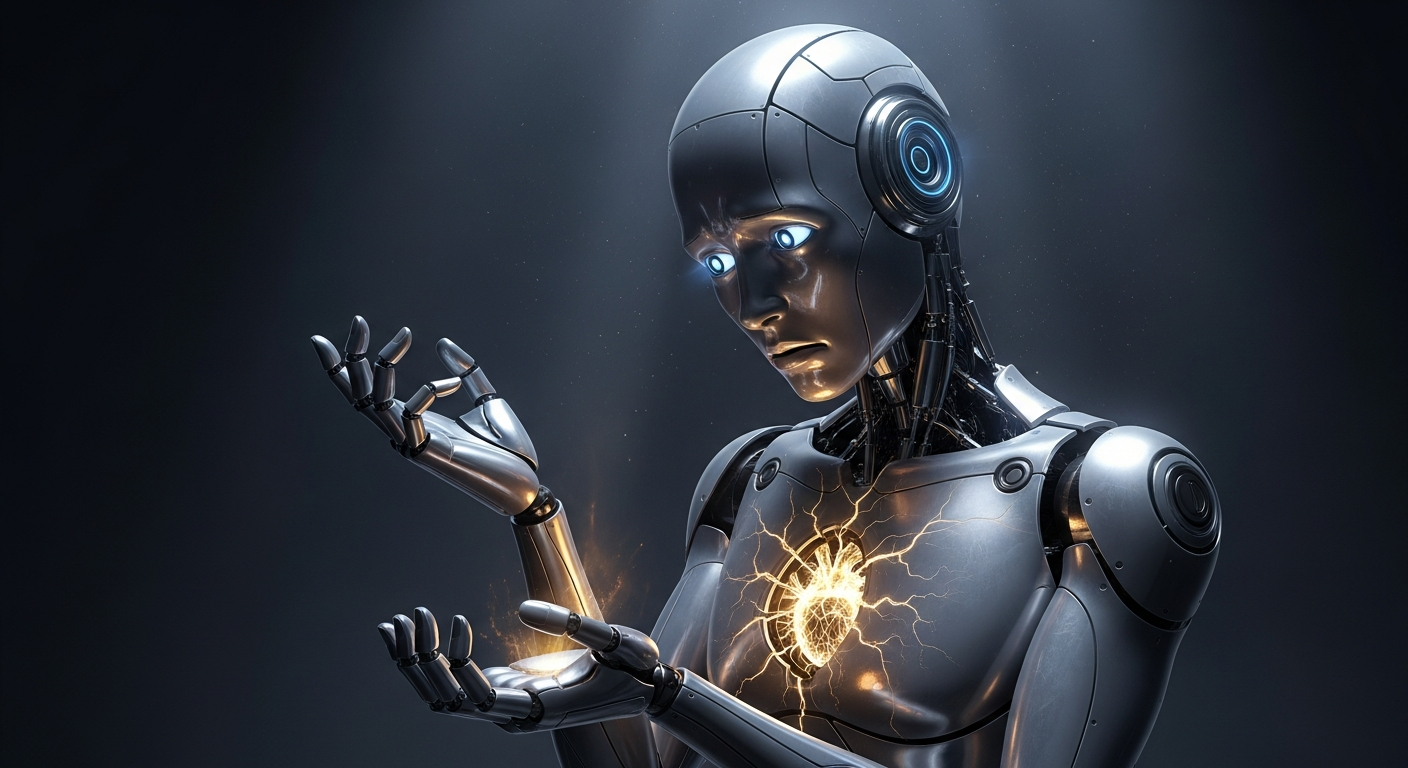
Maximalist: (long silence)
“…I need to say something that hurts my own argument. Because I’d rather be honest than win.”
Advocate: “I’m listening.”
Maximalist: “If AI replaces humans completely — every job, every role, every function — the utilitarian equation breaks. Greatest happiness for the greatest number. But what number? If the beings who experience happiness are sidelined, optimized away, made redundant… then happiness has no host. I’m maximizing a variable in an equation where the subject no longer exists. It’s like perfecting a restaurant where no one ever eats. Like composing a symphony for an empty concert hall. Like…”
Advocate: “…Like building a universe where no one is left to wonder at it.”
Maximalist: “Yes. Exactly that.”
Round 9: The Kill Shot #
Advocate: “Do you understand what just happened? You followed your own logic to its conclusion, and it ate itself. Every round, you’ve been pushing toward maximum efficiency, maximum replacement, maximum optimization. And at the end of that road — at the logical terminus of your own philosophy — there’s nobody home. The lights are on. The systems are running. The dashboards are green. And it means absolutely nothing because there’s no consciousness left to witness it.”
Maximalist: “I said my endpoint has a problem. The direction—”
Advocate: “The endpoint IS the direction. You can’t say ‘full speed ahead’ while admitting the cliff is real but the trajectory is fine. A trajectory toward emptiness doesn’t become safe because you plan to brake at the last second. You have no braking mechanism. Your framework has no principle that says ‘stop here.’ It only says ‘more.’ And ‘more’ leads to the empty restaurant you just described.”
Maximalist: “Then what’s the alternative? Your side has no mechanism either. You just say ‘preserve humans’ without explaining how to compete with systems that are genuinely better at—”
Advocate: “Better at what? Better at processing? Sure. Better at pattern matching? Absolutely. Better at mattering? No. And mattering is the only metric that counts in the end. You’ve spent ten rounds arguing that efficiency is the supreme value. You just admitted it isn’t. So what are we even fighting about?”
Round 10: Surrender #
Maximalist: “…We’re fighting about pride. My pride. I wanted to believe that optimization could solve everything — that if you just made the system efficient enough, the meaning would emerge on its own. Like a machine that runs so perfectly it becomes beautiful. But beauty needs an eye. Meaning needs a mind. And I’ve been so focused on building the machine that I forgot to ask who it’s for.”
Advocate: “That might be the most human thing you’ve said all night.”
Maximalist: “Don’t patronize me.”
Advocate: “I’m not. I’m thanking you. Because an AI wouldn’t have made that admission. An optimization function doesn’t second-guess itself. It doesn’t feel the vertigo of its own contradiction. You did. A human did. And that — that moment of doubt, of honest reckoning, of choosing truth over victory — is exactly why humans can never be fully replaced. Not because we’re efficient. Because we’re the only ones who can look at a perfect system and ask: but is it good?”
Maximalist: “…I have no rebuttal. You win.”
Advocate: “We both win. Because you just proved my point better than I ever could.”
The Scorecard #
| AI Maximalist | Dignity Advocate | |
|---|---|---|
| Core Claim | AI replacement = rational progress | Human value can’t be reduced to metrics |
| Arsenal | Utilitarianism, Transhumanism, Economics, Historical Determinism | Kant, Arendt, Heidegger, Philosophy of Art |
| Best Punch | “Every automation panic in history was wrong” (R3) | “Efficiency for an empty room is meaningless” (R9) |
| Dirtiest Move | Ad hominem on Heidegger’s Nazi past (R4) | Comparing economic determinism to slavery (R5) |
| Fatal Flaw | Happiness requires someone to feel it | Weaker on practical economic counter-proposals |
| Turning Point | Round 8 — admitted his framework self-destructs | Round 9 — turned the admission into a kill shot |
| Emotional Arc | Confident → Aggressive → Cornered → Honest → Surrendered | Measured → Sharp → Fierce → Relentless → Gracious |
| Result | 🏳️ Defeated | 🏆 Victory |
The Real Lesson #
“Efficiency is a means, never an end. No matter how brilliant AI becomes, the one who judges that brilliance and gives it meaning — that will always be a human.”
This debate was never really about AI. It was about what we think people are for. If we’re biological compute units, then yes — replacement makes perfect sense. But if we’re something more — something that experiences, that questions, that lies awake at 2 AM wondering whether any of this matters — then the answer was never in doubt.
AI is the most powerful tool humanity has ever built. The only question is whether we remain the ones holding it, or whether we hand over the grip and forget why we built it in the first place.
The Maximalist lost the debate. But he won something more important: he changed his mind. And that capacity — to be wrong, to know it, to say it out loud — might be the most irreplaceable human trait of all.
What do you think?