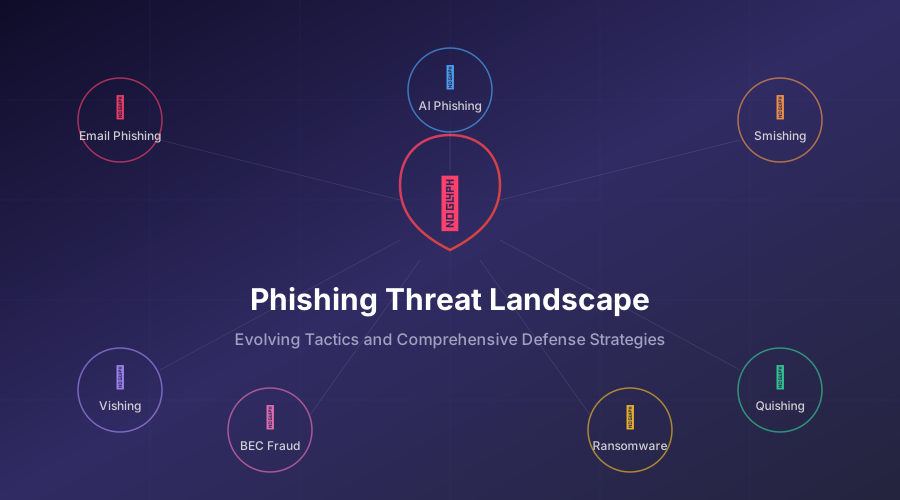
In a world where dozens of emails flood our inboxes daily, a single misguided click can wipe out personal financial assets or paralyze an entire organization. Phishing is one of the oldest forms of cybersecurity threats, yet it remains the fastest-evolving attack vector. In 2025 alone, global damages from phishing attacks exceeded $17 billion, and with advances in AI technology, attack sophistication has reached unprecedented levels. This article provides an in-depth analysis of the latest phishing attack types and tactics, along with effective defense strategies that both organizations and individuals can implement.
Phishing by the Numbers: The Scale of the Threat #
Phishing attacks continue to grow in both volume and sophistication year over year. According to the Anti-Phishing Working Group (APWG), the number of reported phishing sites in 2025 averaged over 4.8 million per month, roughly four times the 2020 figure.
What is particularly alarming is the success rate of phishing attacks. Verizon’s 2025 Data Breach Investigations Report found that 36% of all data breaches used phishing as the initial attack vector. IBM’s Cost of a Data Breach Report 2025 revealed that the average cost of a phishing-initiated breach was $4.76 million, the second highest among all breach types.
The situation is equally dire in specific regions. South Korea’s KISA (Korea Internet & Security Agency) 2025 Cyber Threat Trend Report showed a 67% year-over-year increase in domestic phishing reports, with financial and government institution impersonation accounting for 58% of all cases. Voice phishing alone caused over $600 million in annual damages domestically, making it a critical social issue.
Types of Phishing: From Email to QR Codes #
Phishing is no longer just an email problem. Attackers exploit every available channel to reach victims, deploying sophisticated tactics tailored to each medium.
Email Phishing #
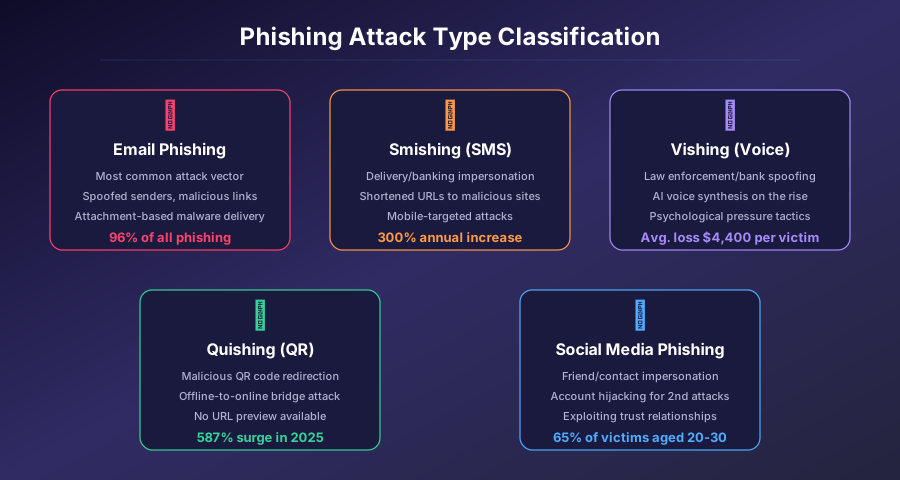
Still the dominant form, accounting for 96% of all phishing attacks. Attackers send emails impersonating legitimate companies or services, luring victims to click malicious links or execute attachments. Recently, HTML Smuggling techniques have surged, bypassing security gateways by encoding malicious code within legitimate HTML files that decode and execute malware in the recipient’s browser.
Smishing (SMS Phishing) #
Delivers malicious links through text messages impersonating package delivery notifications, financial institution verification requests, or government subsidy announcements. The mobile environment makes it difficult to verify full URL paths, and attackers leverage URL shortening services extensively. Particularly prevalent are messages impersonating national health insurance agencies and tax authorities.
Vishing (Voice Phishing) #
Involves phone calls impersonating law enforcement or financial institutions to steal personal information or induce money transfers. Recently, AI Voice Cloning technology has been used to replicate the voices of actual acquaintances or supervisors. In 2024, a multinational company in Hong Kong lost $25.6 million when an employee was deceived by a deepfake video conference that impersonated the company’s CFO.
Quishing (QR Code Phishing) #
The fastest-growing phishing type of 2025. This method directs victims to phishing sites through malicious QR codes, infiltrating offline environments such as parking tickets, restaurant menus, and shared scooters. QR codes exploit the fundamental weakness that humans cannot visually verify URLs. Embedding QR codes as images within email bodies to bypass URL filters is also on the rise.
Social Media/Messenger Phishing #
Attacks through platforms like WhatsApp, Telegram, and Instagram DMs, impersonating known contacts. The typical pattern involves hijacking existing accounts and conducting secondary phishing against the account’s contact list. Social engineering messages like “I urgently need money” or “Is this you in this photo?” are commonly used.
The Phishing Kill Chain: Understanding the Attack Lifecycle #
Phishing attacks are neither accidental nor simple. Analyzed through the Cyber Kill Chain framework, they follow a systematic series of stages.
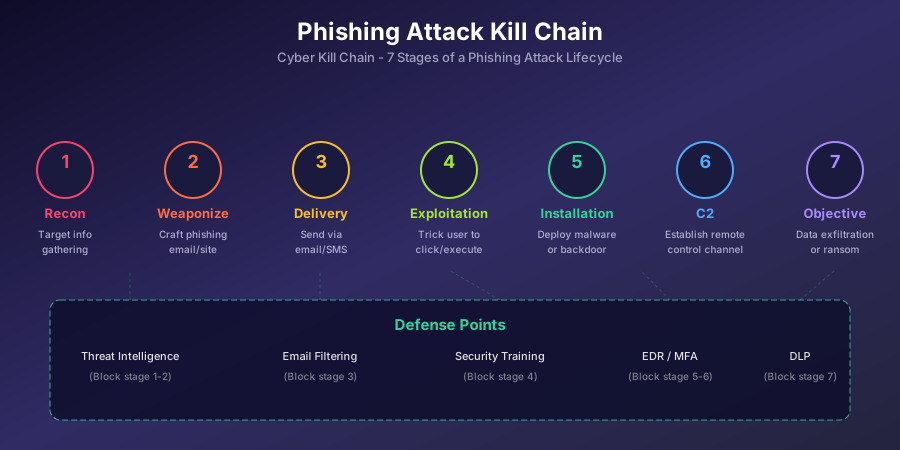
During the Reconnaissance stage, attackers gather information through the target’s social media, LinkedIn profiles, and corporate websites. Organizational charts, email formats, business terminology, and recent projects are all targets for intelligence gathering.
In the Weaponization stage, phishing emails or fake websites are crafted based on collected information. Attackers register domains similar to legitimate ones (e.g., micr0soft.com) and build login pages virtually indistinguishable from the real thing.
Through the Delivery and Exploitation stages, once the victim clicks a malicious link or executes an attachment, the Installation stage deploys malware into the system. Subsequently, C2 (Command & Control) communication enables the attacker to remotely control the system, ultimately achieving the Objective of data exfiltration or ransomware deployment.
The key insight is that disruption is possible at any stage of this kill chain. Defenders need a Defense in Depth strategy that addresses each stage.
Spear Phishing and BEC: The Danger of Targeted Attacks #
Unlike mass phishing campaigns, spear phishing precisely targets specific individuals or organizations. Attackers craft highly convincing messages based on deep reconnaissance, achieving success rates of 40-70%.
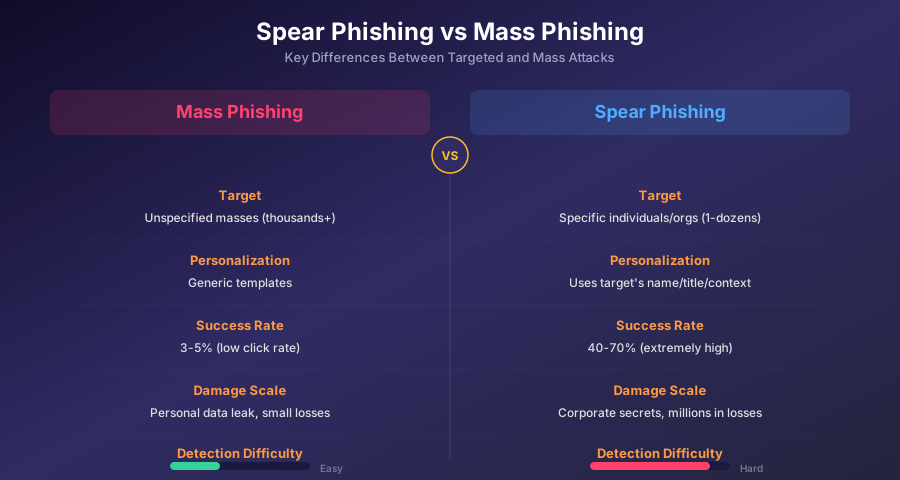
The most dangerous form of spear phishing is BEC (Business Email Compromise). According to the FBI’s IC3 reports, BEC holds the top position in cumulative losses among cybercrime types, with total damages exceeding $12 billion over the three years from 2023 to 2025.
Common BEC scenarios include:
- CEO Fraud: Impersonating the CEO or executives to instruct finance staff to make urgent wire transfers
- Vendor Impersonation: Hacking vendor email accounts or using similar domains to request payment account changes
- Attorney Impersonation: Leveraging fabricated confidential deals to induce urgent, secretive transfers
- Payroll Fraud: Targeting HR departments to request changes to employee payroll accounts
In 2025, major corporations in South Korea reported BEC losses amounting to tens of millions of dollars. Attackers hacked overseas partner email accounts and seamlessly inserted themselves into existing email threads to change payment accounts.
The Evolution of AI-Powered Phishing: A Game Changer #
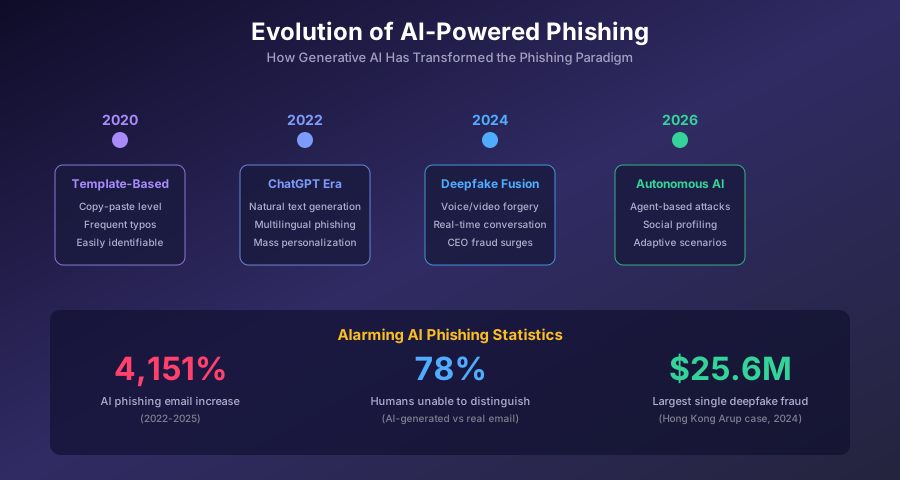
Generative AI has fundamentally changed the phishing landscape. Previously, grammatical errors, awkward phrasing, and crude designs served as phishing indicators, but AI-generated phishing messages eliminate these telltale signs almost entirely.
How AI Is Used in Phishing #
Natural Language Generation: Large language models like ChatGPT are exploited to mass-produce grammatically perfect phishing emails tailored to the target’s business context. Even non-English phishing has shed its previously obvious “machine-translated” quality.
Deepfake Voice/Video: AI voice synthesis technology can clone a person’s voice with just three seconds of audio samples. The 2024 Hong Kong Arup incident saw a deepfake-generated CFO video conference successfully deceive an employee into transferring $25.6 million.
Automated Reconnaissance: AI agents automatically collect and profile targets’ social media activity, public posts, and professional information to generate customized attack scenarios.
Adaptive Phishing: AI chatbot-based phishing has emerged that adjusts conversation strategies in real-time based on the victim’s responses. When suspicion is expressed, additional “evidence” is provided; when interest is shown, the push for action intensifies.
Real-World Case Study #
In early 2025, a South Korean IT company experienced an AI-powered spear phishing attack. The attacker used AI to analyze the target employee’s LinkedIn profile and recent presentation materials, then crafted a conference invitation email aligned with the employee’s interests. The email naturally incorporated the employee’s recent project names and technical keywords, and the sender impersonated a real conference committee member. When the employee clicked the “Register” link, their credentials were stolen, enabling the attacker to successfully infiltrate the corporate network.
How to Identify Phishing Emails: Look with Suspicious Eyes #
While AI is increasing phishing sophistication, detectable indicators still exist.
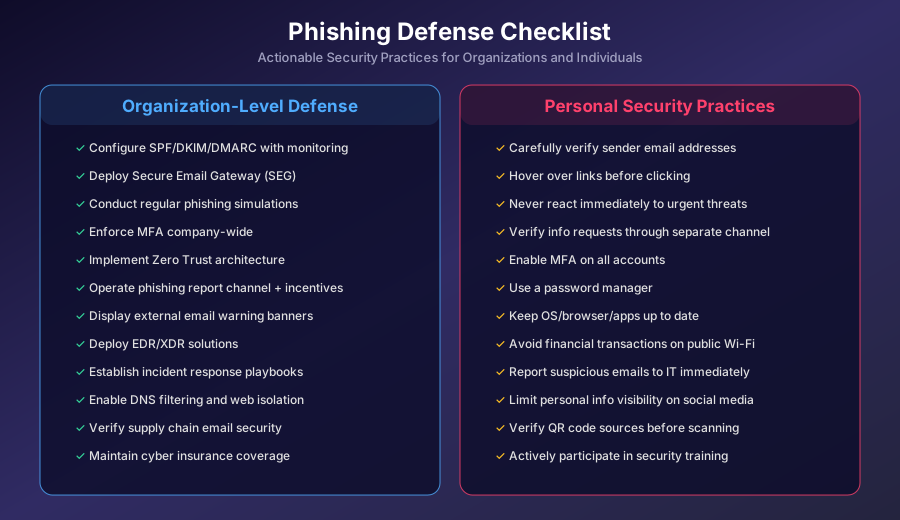
Scrutinize the sender address. Check the actual email address, not just the display name. Watch for subtle variations like support@amaz0n-service.com or hr@company-portal.net. Develop the habit of verifying domain spellings character by character.
Be wary of urgency and threats. Messages like “Your account will be suspended within 24 hours” or “Immediate legal action will be taken unless you verify now” are classic phishing characteristics. Legitimate organizations do not send urgent legal threats via email.
Question links and attachments. Hover over links to verify the actual URL, and do not click if the displayed text differs from the destination. Exercise extreme caution with executable attachments (.exe, .scr, .zip).
Guard against information requests. When passwords, social security numbers, or account numbers are requested via email or message, contact the organization directly through their official phone number.
Detect contextual anomalies. If a supervisor who rarely emails you suddenly requests an urgent wire transfer, or a vendor abruptly asks to change payment accounts, verify through a separate channel (phone or in person).
Technical Defenses: From SPF/DKIM/DMARC to Zero Trust #
Technical defenses against phishing extend from email authentication protocols to network architecture.
The Email Authentication Trio: SPF, DKIM, DMARC #
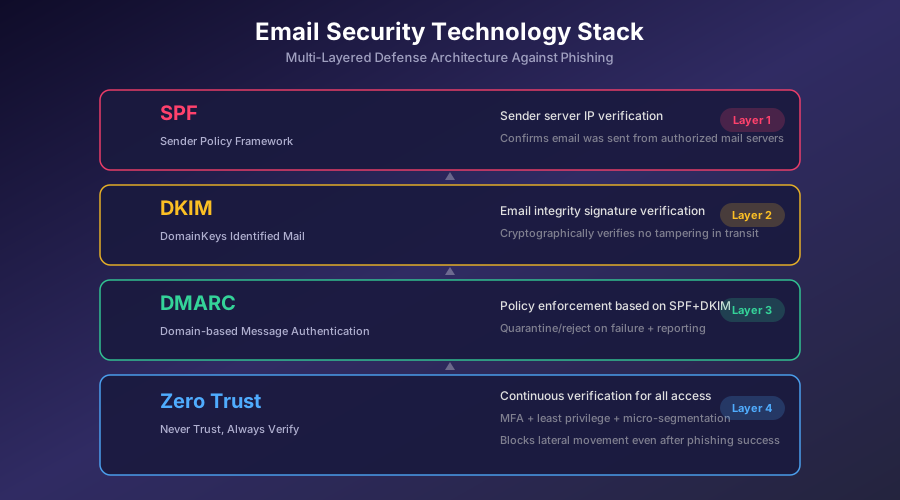
SPF (Sender Policy Framework) allows domain owners to register authorized mail server IPs in DNS. Receiving servers verify whether the sending server’s IP is listed in the SPF record.
DKIM (DomainKeys Identified Mail) adds a digital signature to emails, which receiving servers verify using the public key published in DNS. This confirms that the email was not tampered with during transit.
DMARC (Domain-based Message Authentication, Reporting and Conformance) aggregates SPF and DKIM results and specifies a policy for handling failed authentication: none (monitoring only), quarantine (spam isolation), or reject (block). It also sends authentication result reports to domain owners.
These three protocols effectively block domain impersonation-based phishing. However, as of 2025, approximately 25% of Fortune 500 companies still have not set DMARC to reject mode, leaving gaps in protection.
Zero Trust Architecture #
Zero Trust, built on the principle of “Never Trust, Always Verify,” plays a critical role in minimizing damage even when phishing attacks succeed.
- Multi-Factor Authentication (MFA): Even if passwords are stolen, additional authentication factors block unauthorized access. FIDO2/WebAuthn-based passkeys are fundamentally phishing-resistant authentication methods.
- Least Privilege Principle: Granting users only the minimum permissions needed for their work limits the scope of access when accounts are compromised.
- Micro-Segmentation: Granular network segmentation blocks attacker lateral movement.
- Continuous Verification: User behavior patterns, access locations, and device states are continuously monitored, with immediate additional authentication requirements or access blocks triggered upon anomaly detection.
Organizational Response: The Trinity of People, Process, and Technology #
Technical solutions alone cannot fully prevent phishing. Ultimately, it is people who click on phishing emails, and organizational security culture becomes the last line of defense.
Security Awareness Training #
Rather than one-time training sessions, continuous security awareness programs following an annual plan are essential. Phishing simulation exercises are the most effective method for testing and improving employee response capabilities in real-world conditions. According to KnowBe4, organizations conducting regular phishing simulations saw an average 86% reduction in phishing click rates.
Critically, training must occur within a culture of learning, not blame. Punishing employees who fall for phishing simulations discourages reporting and weakens security. Instead, positive reinforcement through incentives for reporting phishing is more effective.
Incident Response Framework #
Having a system for rapid response when phishing incidents occur is crucial. Key components include:
- Phishing Report Button: Install one-click report buttons in email clients to simplify suspicious email reporting.
- Automated Analysis: Automatically analyze reported emails and search for and remove other emails from the same phishing campaign across the organization.
- Response Playbooks: Develop pre-defined response procedures for each phishing type, with detailed documentation for scenarios including credential theft, malware infection, and BEC.
- Communication Plan: Pre-establish notification procedures for internal staff, customers, and regulatory bodies in case of incidents.
Supply Chain Security #
No matter how strong your own security is, a hacked vendor or partner email exposes you to BEC attacks. Verify email security standards with key business partners, and establish processes requiring confirmation through pre-agreed separate channels for critical requests like payment account changes.
Personal Security Practices: Defense Starts with You #
Independent of organizational security policies, personal security practices form the foundation of phishing defense.
Enable MFA on all accounts. Activate it on every service that supports it: email, cloud services, social media, and financial services. Authentication apps (Google Authenticator, Microsoft Authenticator) or hardware keys (YubiKey) are more secure than SMS verification.
Use a password manager. Tools like 1Password and Bitwarden generate and manage unique, complex passwords for each service. Password managers also provide an added layer of protection because they only auto-fill after verifying the URL, meaning passwords will not auto-fill on phishing sites.
Keep software up to date. Apply security updates for operating systems, web browsers, and email clients without delay. A significant portion of malware delivered through phishing exploits known vulnerabilities.
Minimize personal information exposure on social media. Publicly available information like birthdays, schools, workplaces, and travel schedules become ammunition for spear phishing. Regularly review and restrict profile visibility to the minimum necessary.
Be cautious with QR codes. Do not scan QR codes of unknown origin. Verify that your smartphone’s QR code reader supports URL previews, and always check the URL before proceeding.
Conclusion: How to Win the War Against Phishing #
Phishing attacks target human psychology, not technological vulnerabilities. That is why technical defenses alone cannot provide a complete solution – human awareness and behavior must change as well. As AI makes phishing more sophisticated, AI-powered defense technologies are also advancing. Machine learning-based email filtering, natural language analysis for phishing detection, and behavior analysis-based anomaly detection are leading examples.
Ultimately, phishing defense comes down to the trinity of technology + process + people. Deploy the latest security technologies, establish clear processes, and internalize a security culture through continuous education and training. Phishing will not disappear. But with proper preparation and response frameworks, you can minimize damage and effectively protect both your organization and yourself.
Remember that a single click can change everything. Suspicion is the first step toward security.