“That racing heartbeat you feel — is it real love, or is your brain running a con on you?”
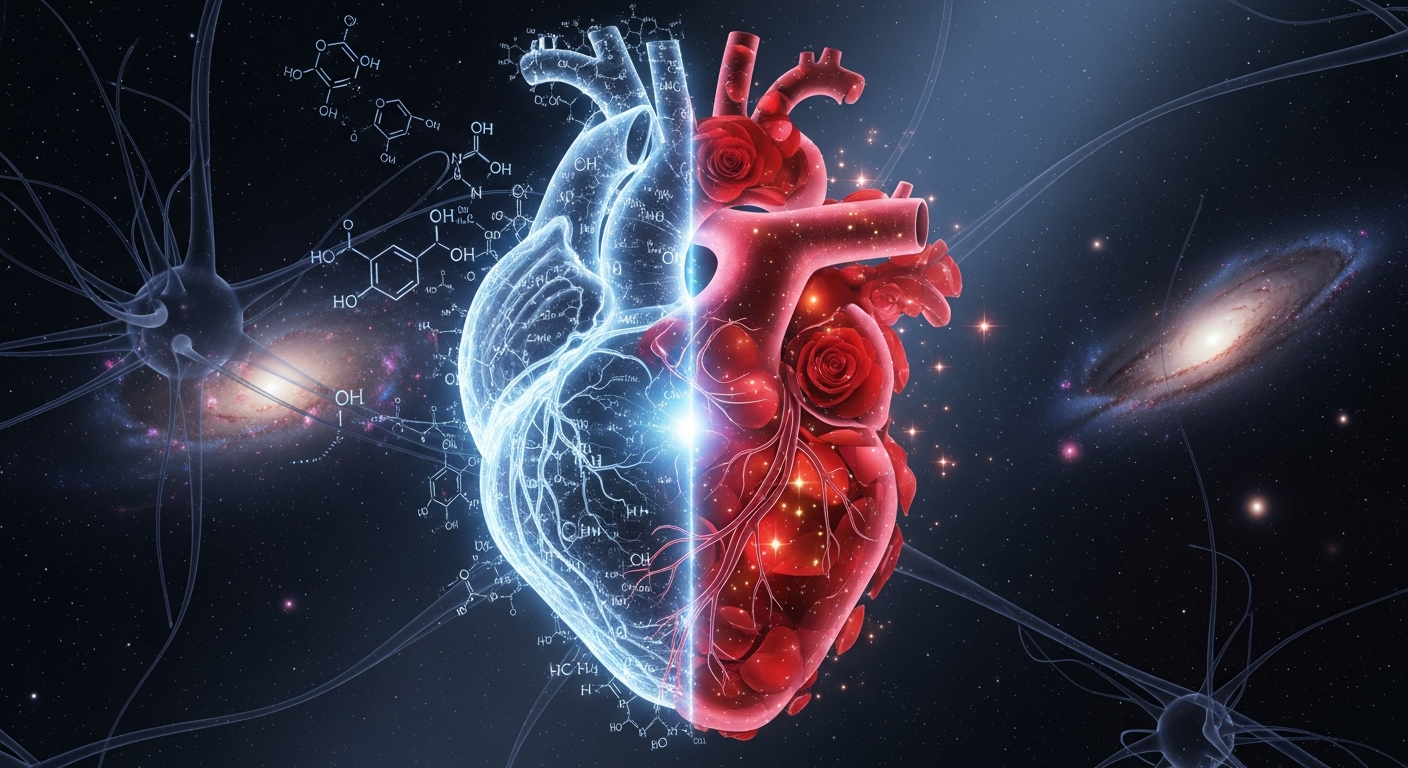
Two opponents sit across from each other. One believes love is as real as the universe itself. The other is convinced that the word “love” is nothing more than a poetic label slapped on neurotransmitter activity. Ten rounds. No referee. No mercy.
Round 1 — Opening: Movement of the Soul vs. Chemistry of the Brain #
The Realist: Plato argued in the Symposium that love is the movement of a deficient soul striving toward wholeness. Eros is not mere desire — it is the most fundamental impulse of human existence, reaching toward Beauty itself, toward Goodness itself. It cannot be reduced to matter. It is a metaphysical reality.
The Reductionist: A beautiful piece of poetry. But what you call “the movement of the soul” is simply elevated dopamine levels and suppressed prefrontal cortex function. Helen Fisher’s fMRI studies confirmed it: the brain of a person in love is neurologically indistinguishable from the brain of a cocaine addict. Both show the same reward pathways lighting up. If Plato had access to a brain scanner, he would have written a very different dialogue.
Scorecard: Even. The Reductionist’s fMRI card lands hard, but the Realist’s foundation holds.
Round 2 — Counterattack: Trace vs. Essence #
The Realist: Brain scans show the trace of love — not love itself. Erich Fromm nailed this in The Art of Loving: love is not a feeling, it is a volitional act. It is a personal commitment that cannot be dissolved into chemistry. When someone chooses to love — through hardship, through change, through the slow erosion of infatuation — that choice does not come from dopamine. It comes from human freedom.
The Reductionist: Even that “volitional choice” is the product of evolutionary engineering. Oxytocin creates bonding. Vasopressin maintains monogamous behavior. What you call a free decision is your genes’ instructions dressed up as autonomy. Schopenhauer saw this clearly — behind every romantic passion, the blind Will to survive and reproduce is laughing at you.
Scorecard: Reductionist edges ahead. The vasopressin data is formidable.
Round 3 — Escalation: The Loves That Break Evolution’s Rules #
The Realist: Then explain this: why do humans regularly love in ways that actively harm their genetic interests? A spouse who nurses a terminally ill partner for two decades with no possibility of reproduction. Adoptive parents who sacrifice everything for a child with no shared DNA. Same-sex love that produces no offspring whatsoever. These are not evolutionary anomalies — they are the rule in human experience. When a theory accumulates this many exceptions, the exceptions are telling you something the theory can’t.
The Reductionist: Schopenhauer’s answer: the Will is blind and irrational. What you call “transcendent love” is the Will’s most sophisticated hallucination. And adoptive parents? Oxytocin doesn’t check DNA. The brain doesn’t distinguish between biological and adoptive children once attachment forms. Evolution doesn’t need genetic connection — it just needs the bonding mechanism to fire.
Scorecard: Realist pulls ahead. The Reductionist’s counter feels stretched.
Round 4 — Midpoint Twist: The Arranged Marriage Paradox #
The Reductionist: Let’s look at the data on arranged marriages. A landmark study from India found that couples in arranged marriages reported stronger emotional attachment after five years than couples who had married for love. They started with zero romantic feeling and ended up with more. This proves that love is not discovered — it is manufactured. Spend time together, release oxytocin, develop shared routines, and love is synthesized. Love is not a flame you find. It’s a fire you build.
The Realist: That data actually strengthens my position. The fact that people can move from indifference to deep love through shared experience means love is something that develops through attention, understanding, and commitment to another person. Whether the chemistry comes first or last is beside the point — what matters is that humans take that chemical process and make it meaningful. The meaning-making itself is not chemistry. It is consciousness. It is will.
Scorecard: Balanced. A genuinely fascinating paradox.
Round 5 — Long-Distance Love #
The Reductionist: Consider long-distance relationships. Physical contact is the primary driver of oxytocin release. Without it, bonding chemistry drops significantly. And yet some couples sustain fierce love across different continents for years. This is too irrational to be a chemical reaction. Which means… it must be a purely cognitive construction — a composite of memory, imagination, and anticipation. Not real love. A representation of love. The menu, not the meal.
The Realist: And here you’ve accidentally made my argument for me. The representation being more powerful than the physical reality — that is precisely the nature of love as Fromm described it. Love is not a reaction to a stimulus. It is an orientation, a direction of the self toward the other. A longing for someone thousands of miles away, sustained with no chemical reinforcement — that is the strongest evidence that love is a will, not a reflex.
Scorecard: Realist slightly ahead.
Round 6 — Love After Loss #
The Realist: People who love a deceased spouse for the rest of their lives. The person is gone. There is no dopamine trigger, no oxytocin source. The stimulus is absent. And yet the love deepens. Some widows say they loved their partner more fully after death than during life. What chemistry explains that?
The Reductionist: That’s grief, not love. Neuroscience identifies longing as a state where pain circuits and reward circuits activate simultaneously. Feeling love for a dead person is the brain’s mechanism for processing loss — it is not evidence for love as an independent entity existing outside the brain.
The Realist: You’ve just defined love as something that only exists in response to a living stimulus. But if love persists and deepens in the absence of any stimulus, that suggests love is not a reaction — it is a state of the self that transcends its object. Like mathematical truth. Like aesthetic beauty. These exist without requiring a physical referent. Love can too.
Scorecard: Realist strong. The Reductionist is on the back foot.
Round 7 — The AI Companion Problem #
The Reductionist: Now the real challenge. Studies show 37% of AI companion app users report feeling emotions “close to love” toward their app. The app has no consciousness, no feelings, no reality. But the user’s brain responds identically to how it responds to a real partner. This is the kill shot: love is a story the brain tells itself, and the brain doesn’t care whether the other party is real. Love is a movie playing in your head. The screen doesn’t need to be real for you to cry.
The Realist: What you’ve described is the tragedy of human longing, not evidence against love’s reality. People who fall for AI companions are desperately reaching for something they can feel is missing. That reaching — that ache — is the most visceral proof that real love exists as a category. You cannot counterfeit something that doesn’t exist. The existence of a fake Rolex tells you that real Rolexes exist. The existence of AI companions tells you that real love is what humans are actually looking for.
Scorecard: Both strong. The Realist’s counter is stunning.
Round 8 — The Self-Love Paradox #
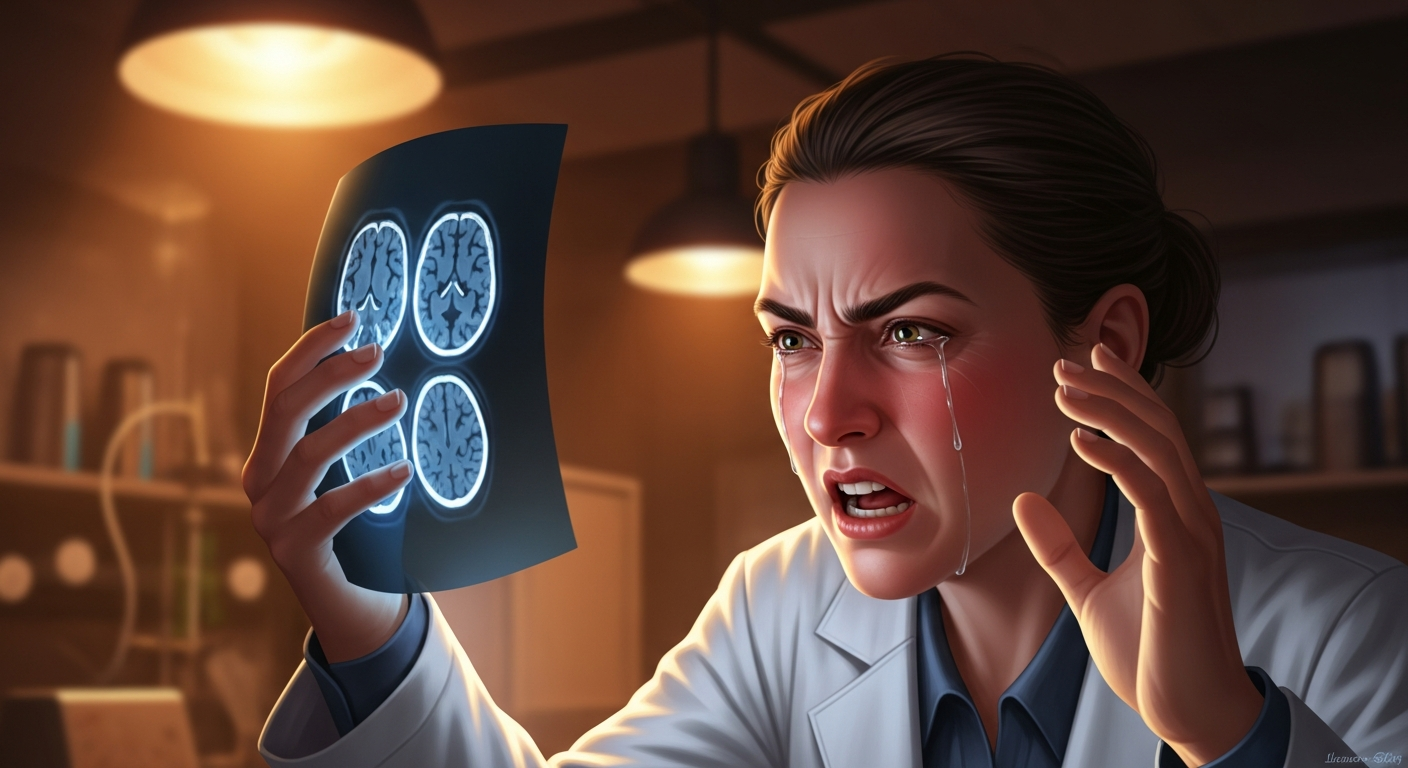
The Reductionist: Consider self-love. Psychologists say healthy self-love is the foundation for loving others. But what is self-love? It requires the self to split — to become both the subject who loves and the object being loved. This cognitive bifurcation shows that love is not a spontaneous feeling but a constructed relationship. Love is not something real that happens to you. It’s something you configure.
The Realist: Why does “cognitively constructed” imply “not real”? Color is cognitively constructed. Meaning is cognitively constructed. Time itself is cognitively constructed. Construction doesn’t negate reality — it is the mode through which reality becomes accessible to consciousness. Fromm’s point about self-love was precisely that love is a capacity — a skill to be developed. Skills require practice, intention, and will. Chemistry doesn’t have a skill. Chemistry just reacts. If love requires skill, it is already beyond chemistry.
Scorecard: Realist clearly ahead.
Round 9 — The Killing Blow: Self-Contradiction Exposed #
The Realist: You have been pouring passion into this debate. That relentless drive to dismantle love, to get to the truth — what do you call that? You are practicing philosophia — the love of wisdom — while denying that love exists. You are doing exactly what Socrates did: pursuing truth with total devotion. And you are calling that a chemical reaction? You are in love with truth right now. You are denying love while loving.
The Reductionist: …Wait. I am genuinely desperate to be right in this exchange. And that desperation… it doesn’t reduce to dopamine. If this drive toward truth were merely chemistry, then chemistry would be questioning itself — which is logically impossible. A chemical reaction cannot doubt its own validity. But I am doubting mine. Which means something beyond chemistry is operating here.
The Realist: Exactly. Only a being capable of doubting love can know the depth of love. Your doubt is the strongest evidence I have that love is real.
Scorecard: Realist decisive. This is the turning point of the entire debate.
Round 10 — Final Resolution: Reality in the Midst of Doubt #
The Reductionist: I concede. I tried to dismantle love and found that the dismantling was itself an act of love — love of precision, love of truth, love of clarity. A chemical reaction cannot negate itself. But I just did. I moved toward something without a physical stimulus to chase me there. If that movement is not love, I don’t know what to call it. I lost.
The Realist: You didn’t lose. Love won — through the most unexpected route: the person who fought hardest against it. Schopenhauer raged against love in every book he ever wrote, yet his prose about love’s power is some of the most passionate philosophy ever recorded. Nietzsche loved truth so intensely he killed God to get closer to it. You loved chemistry so intensely that you arrived at something chemistry cannot explain. That’s not defeat. That’s exactly how love works.
The Reductionist: Then our final agreement is this: love has a chemical substrate, but it consistently generates direction, meaning, and self-reflection that exceed that substrate. A chemical reaction with direction and self-awareness is no longer merely a chemical reaction. I have refuted myself with my own logic.
The Realist: And that is love’s oldest trick — no matter how far you run, it is always the road that brings you back.

Scorecard #
| Criterion | The Realist | The Reductionist |
|---|---|---|
| Philosophical Grounding | Plato (Symposium), Erich Fromm (The Art of Loving), phenomenology | Neuroscience (dopamine/oxytocin), evolutionary psychology, Schopenhauer |
| Core Claim | Love is a personal commitment and the most fundamental truth of existence | Love is a byproduct of chemistry and evolutionary strategy |
| Strongest Blow | “You are denying love while loving” (R9) | “The brain of a person in love is neurologically identical to a cocaine addict” (R1) |
| Round Score | 7 / 10 | 3 / 10 |
| Logic | ★★★★☆ | ★★★★☆ |
| Emotional Power | ★★★★★ | ★★★☆☆ |
| Decisive Moment | R9 — self-contradiction exposed | R4 — arranged marriage data |
| Verdict | Winner (decisive) | Defeated (graceful concession) |
| Best Line | “Only a being capable of doubting love can know its depth” | “A chemical reaction cannot doubt its own validity” |
Every attempt to prove love has always been smaller than love itself. When Plato tried to define Eros, when Schopenhauer tried to dissect it, when neuroscientists tried to scan it — love was already present in the trying.
Love is not something you prove. It is something you cannot let go of, even while doubting it.
Who — or what — are you loving right now?