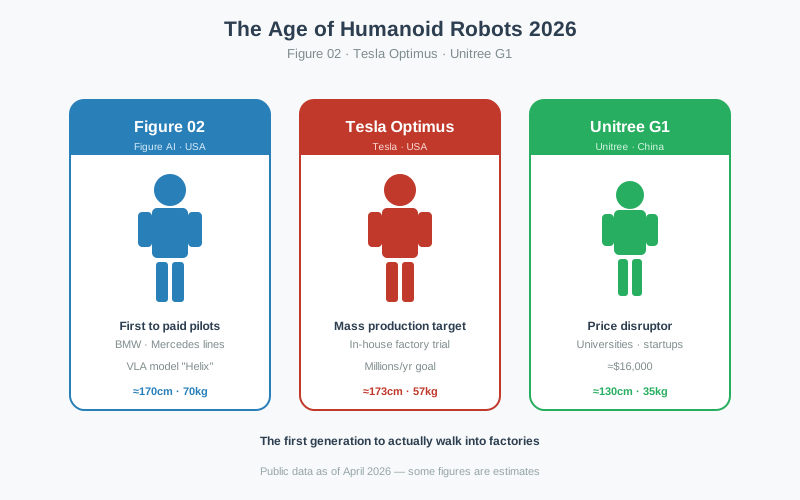
2026 is the year humanoid robots stopped being “that research project from the news” and started being “a coworker who actually shows up on certain factory floors.” Figure 02 is piloting at BMW and Mercedes production lines. Tesla’s Optimus is taking on simple repetitive tasks inside Tesla’s own plants. China’s Unitree G1, at roughly $16,000 per unit, has flooded university labs, startups, and showrooms. This post is not a product catalog — it is a sober look at what this shift actually means.
Why Humanoids, Why Now #
Robot arms and autonomous mobile robots have been standard factory equipment for years. So why are human-shaped robots suddenly interesting again? Because the world itself is built around the human body. Door handles, stairs, desk heights, hand tools, chairs — every one of these was designed for hands and legs at human proportions. A humanoid can enter an existing workplace without structural modifications, one unit at a time. That is the central value proposition.
The second reason is technology convergence. Large language models and multimodal models have delivered a credible “robot brain” that understands instructions in natural language. Simulation and imitation learning have pushed whole-body and hand manipulation into genuinely practical territory. And the unit cost of batteries, motors, and sensors has collapsed. Specs that would have cost millions per unit in 2020 now slot into the low tens of thousands of dollars.
Positioning the Three Frontrunners #
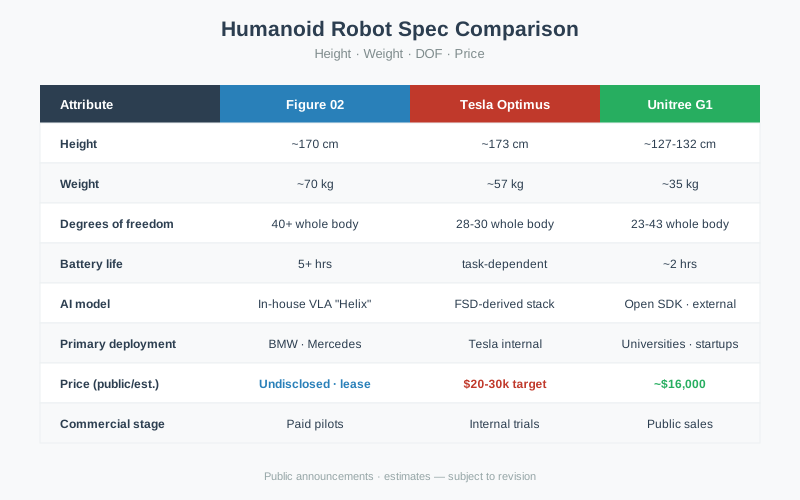
Figure 02 (Figure AI, USA) has moved past its early OpenAI partnership to a self-developed Vision-Language-Action model called “Helix,” and is now the most visible entrant on actual customer floors. At roughly 170 cm and 70 kg, it is deployed at BMW’s Spartanburg plant and Mercedes facilities for metal part handling and simple assembly. It carries real weight as the first major humanoid actually billing paying customers.
Tesla Optimus (Tesla, USA) prioritizes internal deployment first. Demonstrations in 2025 included egg-grasping and garment folding — the fine motor envelope mattered. In 2026, it is being trialed in Tesla’s own battery plants and Gigafactory lines for parts transport and sorting. Musk’s long-horizon roadmap calls for millions of units annually, which, if anywhere close, would exceed the entire cumulative install base of industrial robots.
Unitree G1 (Unitree Robotics, China) bets on accessibility. At roughly $16,000, it undercuts top-tier humanoids by an order of magnitude. It is now the most commonly seen humanoid in university labs, startup demos, and trade show floors. Fine bimanual manipulation is not yet at the top-tier level, but its real role is to be the first humanoid that developers can actually touch and program — and that accessibility is pulling the entire Chinese ecosystem forward faster.
What Makes a Humanoid Actually Useful #
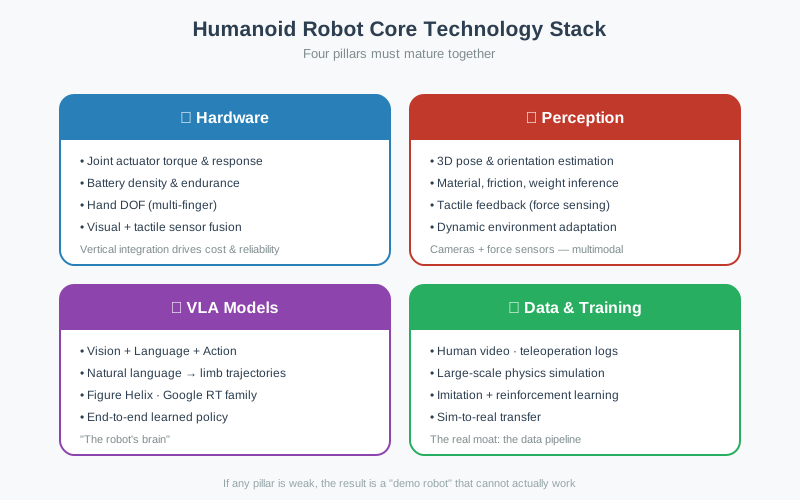
Human-shaped hardware does not automatically mean useful. A humanoid that earns its keep needs four capabilities to mature in parallel.
Hardware: joint actuator torque and response, battery endurance, hand degrees of freedom, and visual plus tactile sensor quality. Figure 02 and Optimus both pursue vertical integration down to custom actuators.
Perception: real-time judgment about where objects are, what orientation, what surface, what compliance. Cameras are not enough — fingertip force sensing plus multimodal fusion is what closes the loop on delicate tasks.
Vision-Language-Action (VLA) models: end-to-end models that take an instruction like “move the red box from that shelf to the conveyor” and produce continuous arm-and-leg trajectories directly from camera input. Figure’s Helix is a public example; Tesla, Google DeepMind, and several Chinese labs all have peers.
Simulation and imitation-learning pipelines: massive combinations of human video, teleoperation recordings, and physics simulation, continuously feeding the training flywheel. The real moat in the humanoid industry right now is not the hardware — it is this data and training pipeline.
Production Ramp vs. Job Disruption #
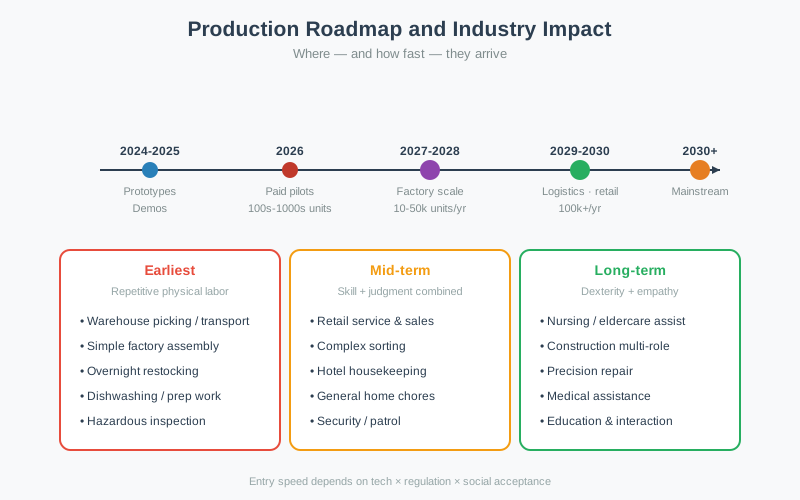
Publicly announced production roadmaps are unusually aggressive. Figure is targeting tens of thousands of units annually within a few years. Tesla has stated a long-run ambition of millions per year. Chinese firms, with state backing, have dozens of companies ramping simultaneously. Not every roadmap will hit its dates, but the direction is unambiguous.
The first sectors affected will be repetitive, standardized physical labor: warehouse picking, factory part transport, overnight retail restocking, kitchen prep and dishwashing. Skilled care work, construction, and precision bimanual trades remain further out.
The real question is not “will robots replace humans?” It is more subtle. In the short term, humanoids fill seats that were already hard to staff — night shifts, hazardous environments, cold storage, chemical handling. The tension builds in the medium term, as the robots accumulate training data and start overlapping with roles humans currently hold. Whether reskilling and redeployment systems can keep pace with that curve is the open societal question.
The Harder Questions #
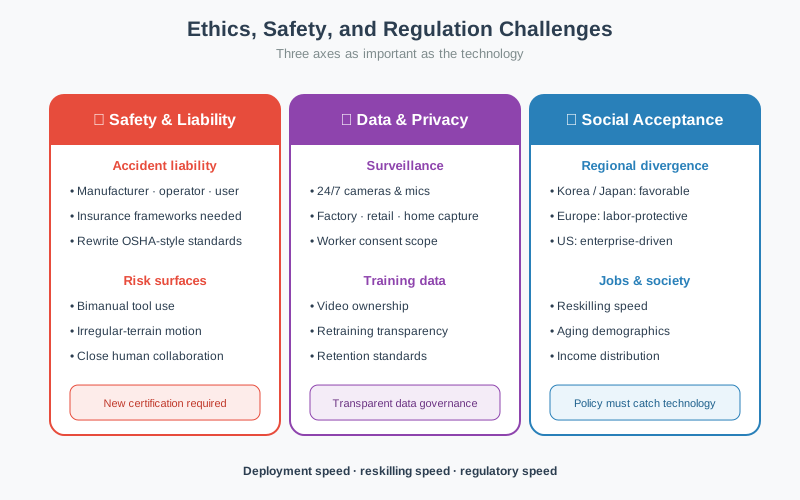
Beyond the technology sits a set of ethics and regulation problems that are genuinely unsolved. When a humanoid walks into a retail store or someone’s home, we need clear answers on liability in the event of harm (manufacturer vs. operator vs. user), on insurance frameworks, and on worker-safety certification. A two-handed humanoid is not a caged robot arm — its risk envelope is fundamentally different, and industrial safety standards need to be rewritten accordingly.
Data and surveillance is the second axis. A humanoid moving through factories, stores, or homes is, by definition, a continuous camera and microphone. Who receives that data, who trains on it, and how long it is retained — almost none of this is yet specified with any precision.
Social acceptance is the third. Cultures vary: South Korea and Japan lean relatively robot-friendly, while much of Europe pairs a stronger labor-protection and privacy stance with slower deployment. The same hardware will diffuse at very different speeds across borders. South Korea, with structural pressure from low birth rates and rapid aging, likely has faster institutional appetite in industry and eldercare — but also an urgent need to build cushioning policy faster.
The most honest take on the 2026 humanoid moment is this: the technology is no longer fiction. It is also not a finished product. The next several years will be defined by three racing speeds — deployment speed, reskilling speed, and regulatory speed — and the balance between them will shape what work looks like in the 2030s.