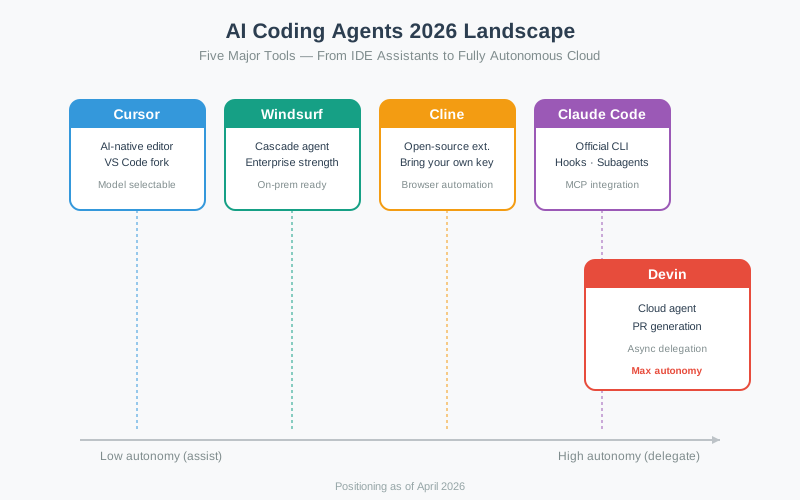
By spring 2026, “AI coding agent” is no longer a research category — it is a daily workflow layer. In roughly twelve months, Cursor, Claude Code, Cline, Windsurf, and Devin have each carved out their own shape inside engineering teams, and the choice between them now materially affects productivity. This post is not a feature list. It is an attempt to frame the five tools the way a working engineer actually needs to think about them.
Why “Agents” Matter Now #
The previous generation of AI coding tools — the original GitHub Copilot, early TabNine — were autocomplete systems. You typed, they guessed the rest. The paradigm shift came in 2025 when model tool-use became reliable enough that the user could delegate tasks: let the model browse the repository, edit files, run tests, read the failures, and try again. That loop is the heart of agentic coding.
Agents differentiate along three axes. Autonomy scope — is the tool suggesting one line, or driving an entire pull request? Integration surface — an editor extension, a standalone CLI, or a cloud service? Context strategy — which model, which memory and retrieval approach, and at what cost? The five tools split cleanly along these axes.
The Architecture of Five Agents #
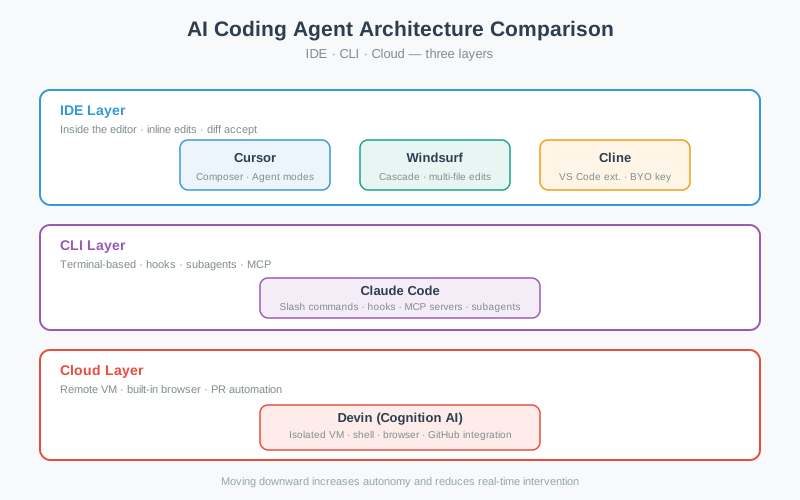
Cursor is a VS Code fork built around AI-native workflows. Chat, Composer, and Agent modes are unified inside the editor, and users pick between GPT, Claude, and Gemini families for the underlying model. Its strength is a diff-based workflow: it proposes multi-file edits, you accept or reject.
Claude Code is Anthropic’s official CLI, released in late 2024 and heavily expanded since. It runs in the terminal, centers on Claude Opus/Sonnet, and exposes deep extension surfaces — filesystem access, bash execution, subagents, hooks, slash commands, and MCP server integration. IDE integration exists, but the tool is CLI-first by design.
Cline (formerly Claude Dev) began life as an open-source VS Code extension. It is model-agnostic — you bring your own API keys — and combines task execution, file editing, and browser automation in a single sidebar. Its transparent, open-source nature makes it a favorite inside security-conscious organizations.
Windsurf, built on Codeium’s infrastructure, ships with a proprietary agent system called “Cascade.” It focuses on large refactors and coordinated multi-file changes, and its enterprise and on-prem story is one of the strongest in the field.
Devin from Cognition AI sits at the autonomy extreme. It is a cloud-hosted “virtual engineer”: hand it a task and it navigates a browser, shell, and editor on its own until a PR is ready. You sacrifice real-time steering and pay the highest price in the category.
Balancing Price and Autonomy #
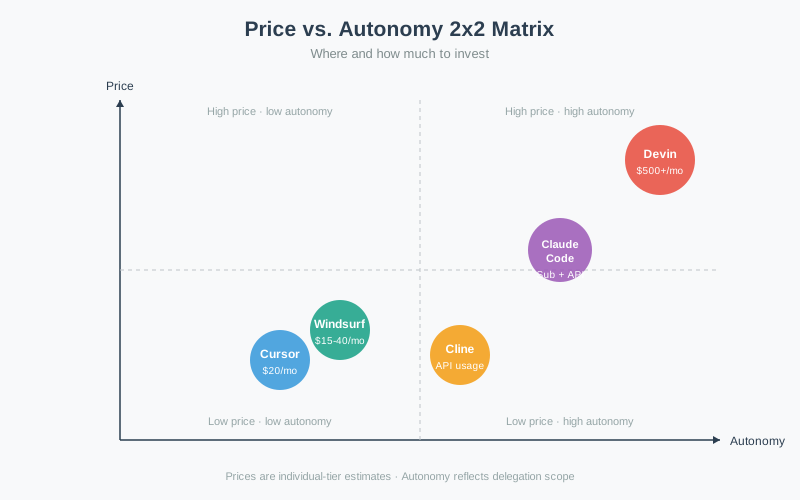
The most common mistake in tool selection is treating price as a proxy for quality. The real question is whether the task actually needs the autonomy you are paying for.
Cursor and Windsurf sit at the $20–$40 monthly subscription range and optimize for fast iteration inside the editor. They shine for the everyday “draft this feature in an hour” cycle. Claude Code and Cline blend subscription and usage-based billing. Claude Code supports both Claude subscriptions and API-based billing, while Cline is almost purely API-metered — which gives it unusually predictable costs. In return, their CLI- and extension-based foundations scale into automation, hooks, and subagent orchestration for long sessions.
Devin is a different category entirely. Starting at roughly $500/month, it is priced for delegating work, not for assisting typing. It is a waste for small edits, but when the brief is “complete the framework migration while I sleep,” the math starts to make sense.
The Feature Matrix That Actually Matters #
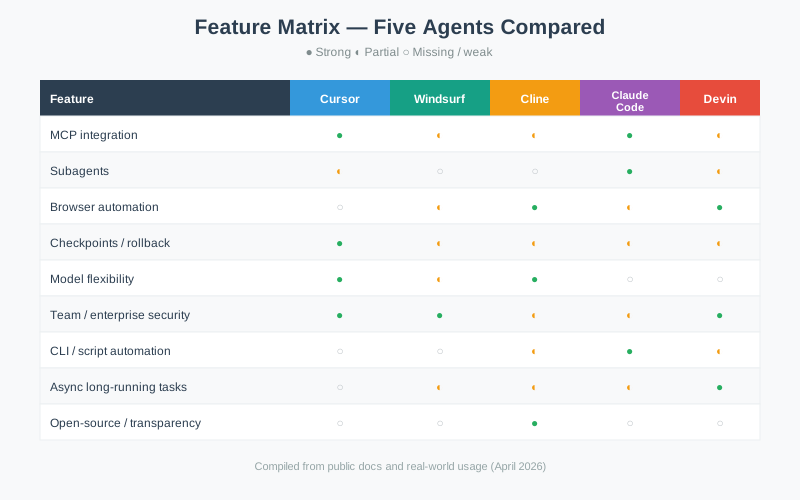
All five share the basic “file editing plus chat” substrate. The differentiation is in the adjacent capabilities. MCP (Model Context Protocol) integration is most mature in Claude Code and Cursor, letting an agent reach directly into external tools, databases, or issue trackers. Subagents and slash command systems are most developed in Claude Code, making team-level configuration sharing straightforward. Browser automation is native to Cline and Devin, which is valuable for UI QA or scraping-mixed work. Checkpoint and rollback is cleanest in Cursor, handled at the editor level. Enterprise security — SSO, audit logs, on-prem — is strongest in Windsurf and in Cursor’s team plans.
The decision hinges on the work type you repeat most. A frontend developer producing UI views all day will feel Cursor’s speed advantage viscerally, while a backend engineer running long refactoring sessions will lean on Claude Code’s CLI + hooks combination. Security-constrained organizations often land on Cline as the easiest entry point, and true async delegation remains Devin’s territory.
A 2026 Workflow Proposal #
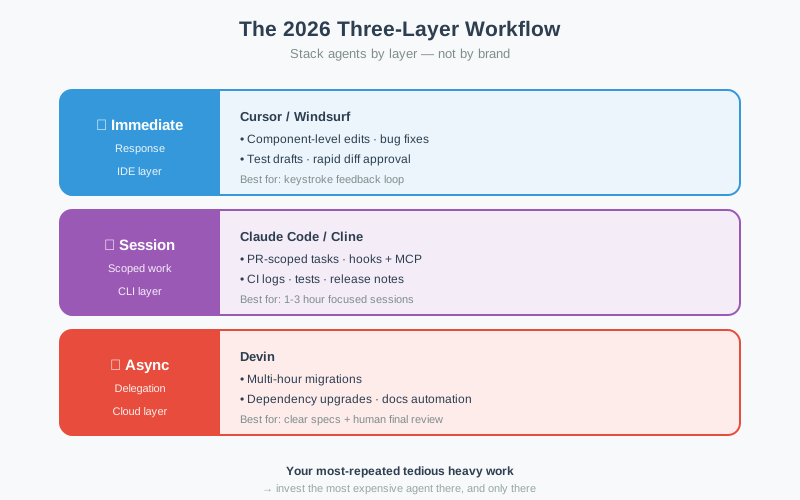
In practice the strongest teams are not picking one tool. They are stacking agents by layer.
Immediate-response layer: Cursor or Windsurf inside the editor for the keystroke-level feedback loop — component edits, bug fixes, fast test drafts.
Session layer: Claude Code or Cline, driven by slash commands, subagents, and hooks, to close out PR-scoped work in one extended session. CI logs, test results, and release notes all become agent territory.
Async delegation layer: Devin, for multi-hour migrations, docs automation, and large dependency upgrades where a detailed spec is feasible and humans only step back in to review the final PR.
The cost-effective move in 2026 is to map your own most-repeated “tedious and heavy” work onto exactly one of those layers — and only then invest in the expensive end. AI coding agents are no longer a “should I use this?” question. They are a “where and how much do I delegate?” question, and the answer is now a portfolio decision.