Fiber optic communication transmits data using light as the medium. Commercialized in the 1970s, it has since become the backbone of the internet, transoceanic cables, and data center networks. With transmission speeds thousands of times faster than copper and reach extending tens of kilometers, modern communications infrastructure simply cannot function without fiber optics.
1. Core Principle — Total Internal Reflection (TIR) #
The physical foundation of fiber optics is Total Internal Reflection (TIR). When light travels from a medium with a higher refractive index (the core) to one with a lower index (the cladding), it completely reflects back if the angle of incidence exceeds the Critical Angle — no light escapes.
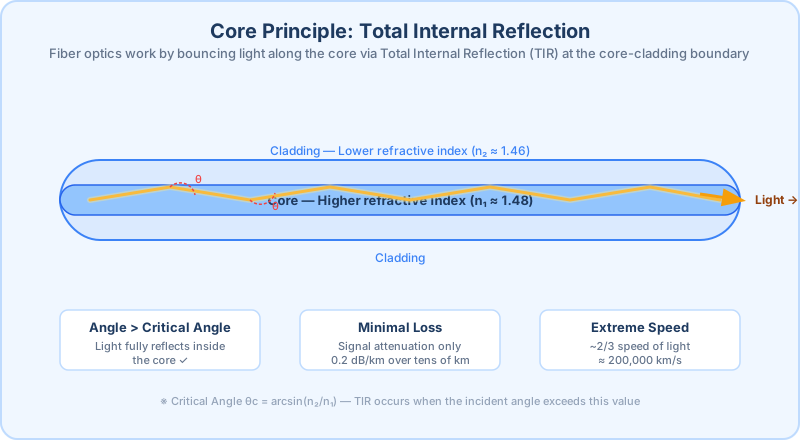
The critical angle is derived from Snell’s Law:
|
|
With n₁ ≈ 1.48 (core, silica glass) and n₂ ≈ 1.46 (cladding), the refractive index difference is only about 1.4% — yet it’s enough to trap light inside a “photonic pipe” for tens of kilometers.
Light travels through the fiber at roughly 2/3 the speed of light in a vacuum: approximately 200,000 km/s. While this is similar to an electrical signal in copper, the bandwidth — the amount of information it can carry — is incomparably larger.
2. Fiber Optic Cable Structure #
A fiber optic cable is built from four concentric layers.
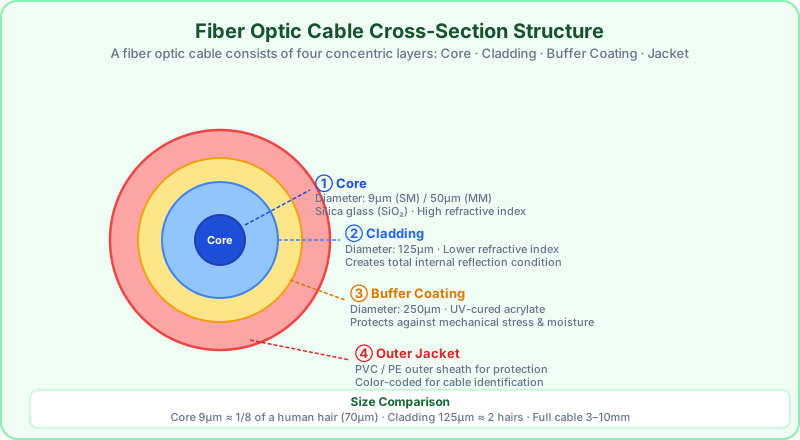
| Layer | Diameter | Material | Role |
|---|---|---|---|
| Core | 9μm (SM) / 50μm (MM) | Ultra-pure silica (SiO₂) | Light propagation path |
| Cladding | 125μm | Lower-index glass | Establishes TIR condition |
| Buffer Coating | 250μm | UV-cured acrylate | Protection against shock and moisture |
| Jacket | 3–10mm | PVC / PE | Outer sheath, color coding |
The 9μm core diameter is 1/8 the thickness of a human hair (~70μm). Inside this impossibly thin glass strand, light travels fast enough to circle the Earth five times per second.
3. Full Fiber Optic System Architecture #
A fiber optic system follows three main stages: Transmitter → Fiber → Receiver.
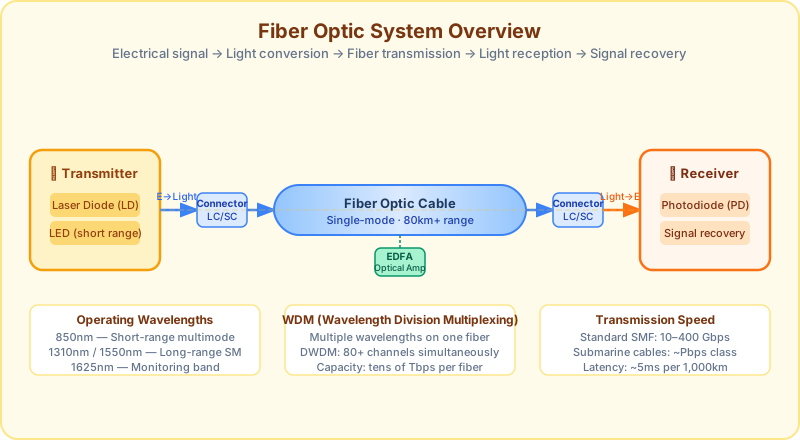
At the transmitter, electrical signals are converted into light using a Laser Diode (LD) or LED. Long-haul links use laser diodes for their wavelength stability, operating at 1310nm or 1550nm.
EDFA (Erbium-Doped Fiber Amplifier) amplifies the optical signal directly — without converting it back to electricity — and is placed every 60–80km along long-distance routes. This allows signals to travel hundreds of kilometers without repeaters.
WDM (Wavelength Division Multiplexing) stacks multiple wavelengths of light onto a single fiber simultaneously. DWDM systems use 80+ channels to push a single fiber’s capacity to tens of Tbps.
4. Single-Mode vs Multi-Mode #
Fiber is broadly divided into two types based on core diameter and light propagation behavior.
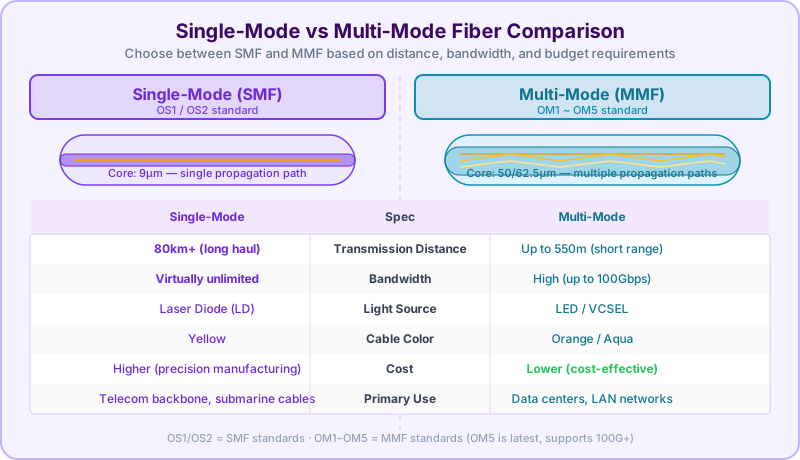
Single-Mode Fiber (SMF) has a 9μm core so narrow that light travels in only one path (mode). With no modal dispersion, it supports distances of 80km or more. It’s used in telecom backbones, submarine cables, and inter-city links. Cable color: yellow.
Multi-Mode Fiber (MMF) has a 50–62.5μm core, allowing multiple light paths to coexist. Modal dispersion (path length differences) limits it to around 550m maximum — but it’s cheaper and well-suited for data center interconnects, LANs, and SANs. The latest standard, OM5, supports 100G+. Cable color: orange or aqua.
5. Fiber Optic vs Copper Cable — Head-to-Head #
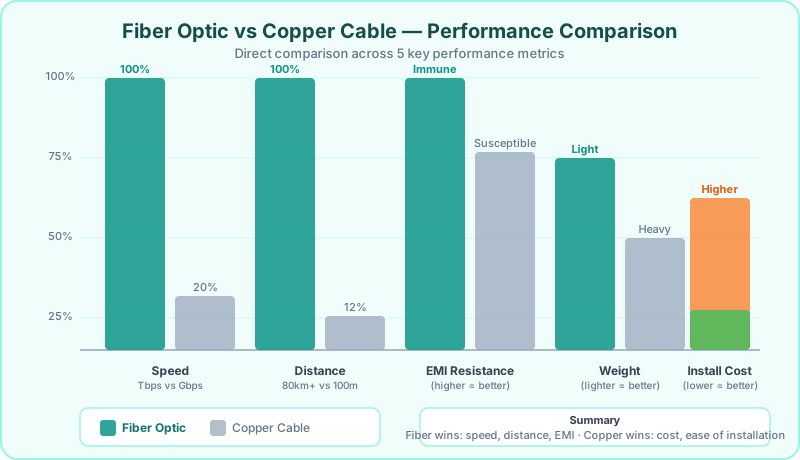
There are clear domains where fiber dominates, and others where copper retains its advantage.
Fiber wins:
- Speed: Cat6A copper tops out at 10Gbps over 100m. Fiber with DWDM reaches tens of Tbps.
- Distance: Ethernet copper is limited to 100m. Single-mode fiber runs 80km+ without repeaters.
- EMI immunity: Light is entirely immune to electromagnetic interference — critical in industrial environments.
- Weight and size: Much lighter and thinner than copper for equivalent bandwidth.
- Security: Any physical tap causes measurable signal loss, making eavesdropping extremely difficult.
Copper wins:
- Initial cost: Fiber transceivers (SFP modules), fusion splicers, and optical connectors carry a premium.
- Power over Ethernet (PoE): Copper can deliver power alongside data — fiber cannot.
- Ease of installation: Copper crimping is straightforward; fiber splicing requires specialized equipment and training.
6. Real-World Applications of Fiber Optics #
Fiber optic technology is deeply woven into daily life:
- Submarine cables: Over 99% of intercontinental internet traffic travels through undersea fiber optic cables. There are currently 400+ submarine cable systems in operation worldwide.
- FTTH (Fiber to the Home): The backbone of gigabit home internet. Every major ISP’s multi-gigabit service relies on fiber.
- 5G backhaul: Fiber connects base stations to the core network, making it indispensable for 5G infrastructure.
- Data center networks: 100G/400G server rack interconnects use OM4/OM5 multi-mode fiber for cost-effective short-range links.
- Medical devices: Fiber bundles deliver light in endoscopes; fiber sensors operate cleanly inside MRI environments free from electromagnetic interference.
Conclusion #
Fiber optics is the circulatory system of modern digital infrastructure. Every time you stream a video, download a file from the cloud, or join a video call — that data is racing through fiber cables at the speed of light.
Understanding the difference between single-mode and multi-mode, and grasping the physics of total internal reflection, makes it clear why fiber is the essential infrastructure of the 5G, cloud, and AI data center era. As quantum optical communication and silicon photonics mature, fiber optics will evolve to become even faster and more cost-effective than it is today.