Since Neuralink published its first human implant recipient controlling a mouse cursor in early 2024, brain-computer interfaces (BCIs) have moved from “distant science fiction” to “an industry with active clinical trials.” As of 2026, dozens of patients worldwide live with various BCI devices implanted, and the US FDA is steadily broadening approvals for specific indications. This post lays out where BCI actually is — and which questions we must answer before the technology leaves the hospital.
Three Ways to Capture Brain Signals #
BCIs fall into three categories by signal-acquisition method.
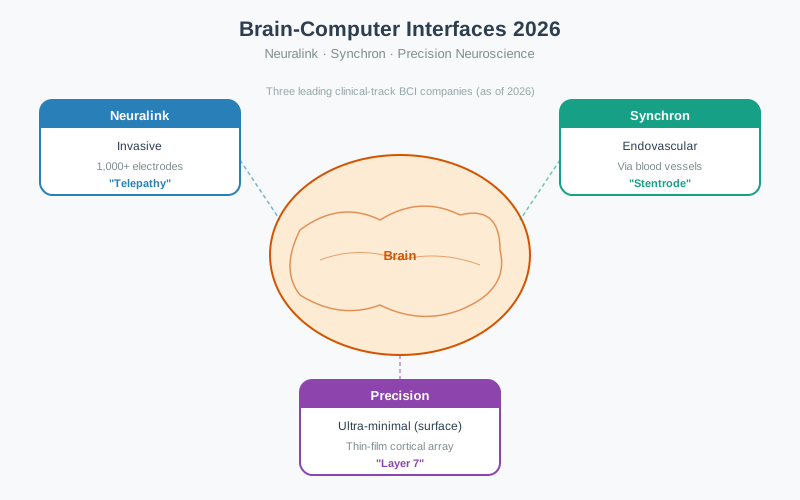
Invasive BCI: Neuralink’s “Telepathy” is the best-known example. More than 1,000 hair-thin electrodes are inserted directly into cortical tissue, recording single-neuron activity. Signal quality is the highest available, but brain surgery is required and long-term biocompatibility is still an open question.
Semi-invasive BCI: Synchron’s “Stentrode” delivers a stent-shaped electrode into the brain’s blood vessels via the jugular vein. No craniotomy is needed, which dramatically reduces surgical risk, and patients have already used these devices at home for years in US and Australian trials. Signal resolution is lower than fully invasive devices, but clinical scalability is much better.
Non-invasive BCI: scalp-based EEG or fNIRS systems. Most accessible, but the signal is far weaker and precise control is hard. Recent decoder advances from machine learning have pushed reliable text entry and basic cursor control within practical range.
The Key Players in 2026 #
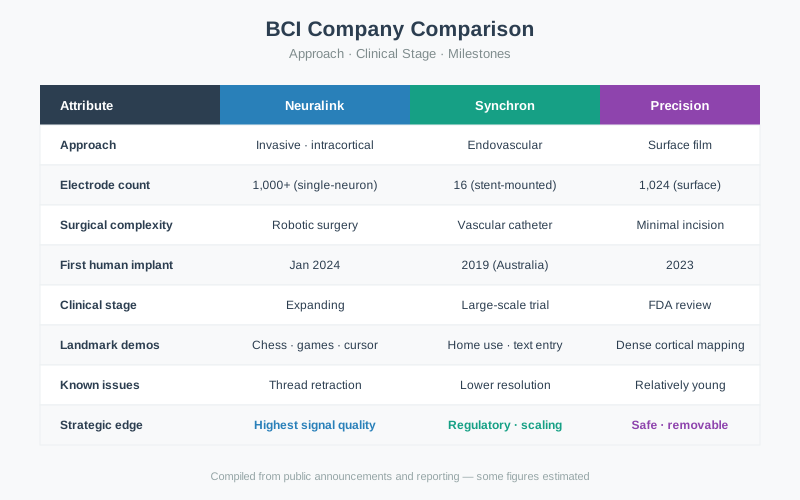
Neuralink (USA) began human implants in January 2024 and has steadily added patients. Public footage shows tetraplegic patients moving cursors and playing chess with thought alone, with capabilities gradually expanding into gaming and everyday communication. A known issue is that some electrode threads retracted in the earliest recipient, leaving long-term stability as open engineering work.
Synchron (Australia/USA) is widely viewed as the furthest along on the regulatory track, thanks to its less invasive delivery method. Backed by NIH-supported trials, it has reached expansion-phase clinical work, and patients use the device at home for text entry and smart-home control.
Precision Neuroscience (USA) draws attention for its “Layer 7” technology — an ultra-thin film electrode placed on the cortical surface without opening the skull. Hospital partnerships are expanding rapidly, and formal FDA clearance work is underway in 2026.
Beyond these, China’s Neuracle, the US-based Neurable (non-invasive), and others are racing in parallel, while Meta and Apple have disclosed research into non-invasive EMG and optical interfaces.
What BCIs Actually Do Today #
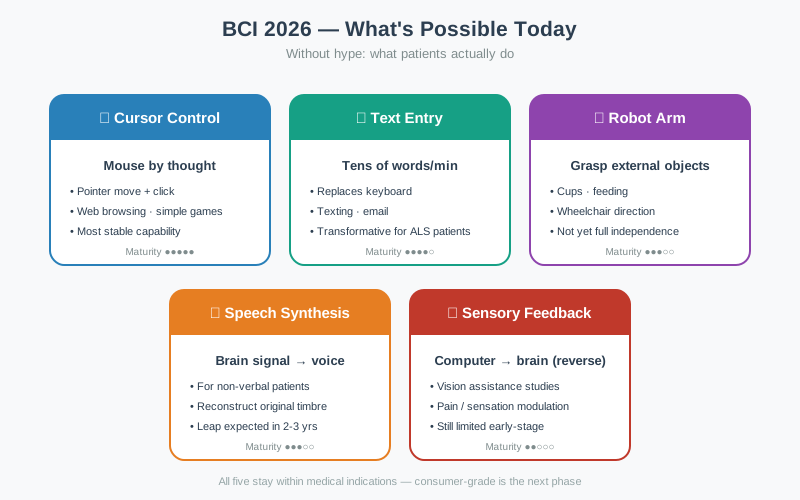
Without hype, these are the things BCI patients actually do as of 2026.
Cursor movement and clicking: the baseline capability. Mouse control, basic web browsing, simple games.
Text entry: research reports show tens of words per minute achievable via thought alone. Still slower than a keyboard, but for someone with no other input channel it is a life-changing capability.
Robotic arm and wheelchair control: patients without arm movement have demonstrated grasping cups and eating with externally mounted robotic arms. Not full independent living yet, but a meaningful milestone.
Speech synthesis: decoding neural signals into a reconstruction of the patient’s original voice is advancing rapidly and is among the most emotionally profound application areas.
Sensory feedback: sending signals back into the brain (rather than just reading) remains more limited, though vision-assist and pain-modulation studies are now in early clinical work.
From Clinic to Consumer — When, Really? #
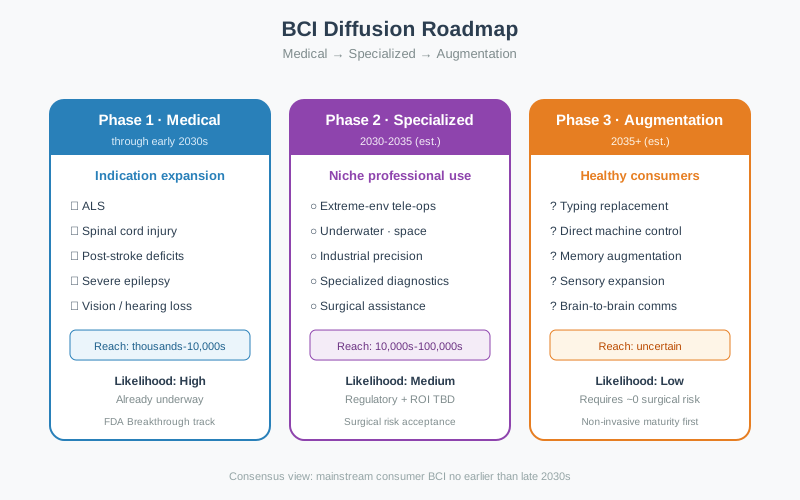
Elon Musk has long described a future where healthy people use BCIs. That stage is still far off. A realistic diffusion roadmap looks closer to:
Phase 1 (now through early 2030s): expansion of medical indications. Approvals broaden for ALS, spinal cord injury, post-stroke deficits, and severe epilepsy.
Phase 2 (estimated 2030-2035): specialized professional use. Beyond medicine, narrow markets like remote operation in extreme environments or restricted-mobility piloting could open.
Phase 3 (post-2035 estimate): augmentation. Healthy users elect BCIs for typing replacement or direct machine control. Crossing this line requires surgical risk approaching zero and clinical confidence in non-invasive or ultra-minimally-invasive technology.
Many experts treat mainstream consumer BCI as a cautious late-2030s scenario at the earliest.
Questions We Need to Answer First #
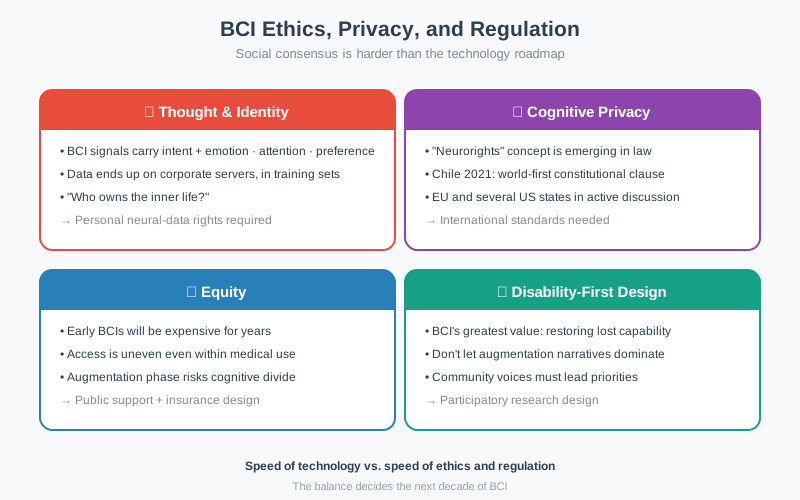
The technology roadmap is the easier part. The social consensus is much harder.
Thought and identity: BCI signals are not purely “movement intent.” They carry fragments of emotion, attention, and preference. If those signals land in corporate servers and feed training data, who owns the user’s inner life becomes a literal question, not a philosophical one.
Cognitive privacy: some jurisdictions have already begun codifying “neurorights.” Chile became the first country to enshrine neurorights in its constitution in 2021, and several US states and EU bodies now have active legislation in discussion.
Equity: BCIs will be expensive for the foreseeable future. Even within medical indications, access is unequal, and any move toward augmentation widens the gap. The possibility that a cognitive divide between BCI users and non-users amplifies existing inequality is not hypothetical.
Disability-first design: the most immediate and powerful value of BCI is restoring lost capability. Before industry narratives drift toward augmentation, disability communities are pushing — rightly — for their priorities to lead the research agenda.
BCI in 2026 sits somewhere between “scientific laboratory” and “consumer product” — in the early commercialization phase inside clinical settings. The technology genuinely has the power to restore someone’s life in ways nothing else can. It simultaneously creates an entirely new category of power: companies that collect brain data. Whether the pace of technical progress stays in step with the pace of ethical and regulatory progress will determine whether the next decade of BCI becomes “a tool of healing” or “the starting point of a new inequality.”